

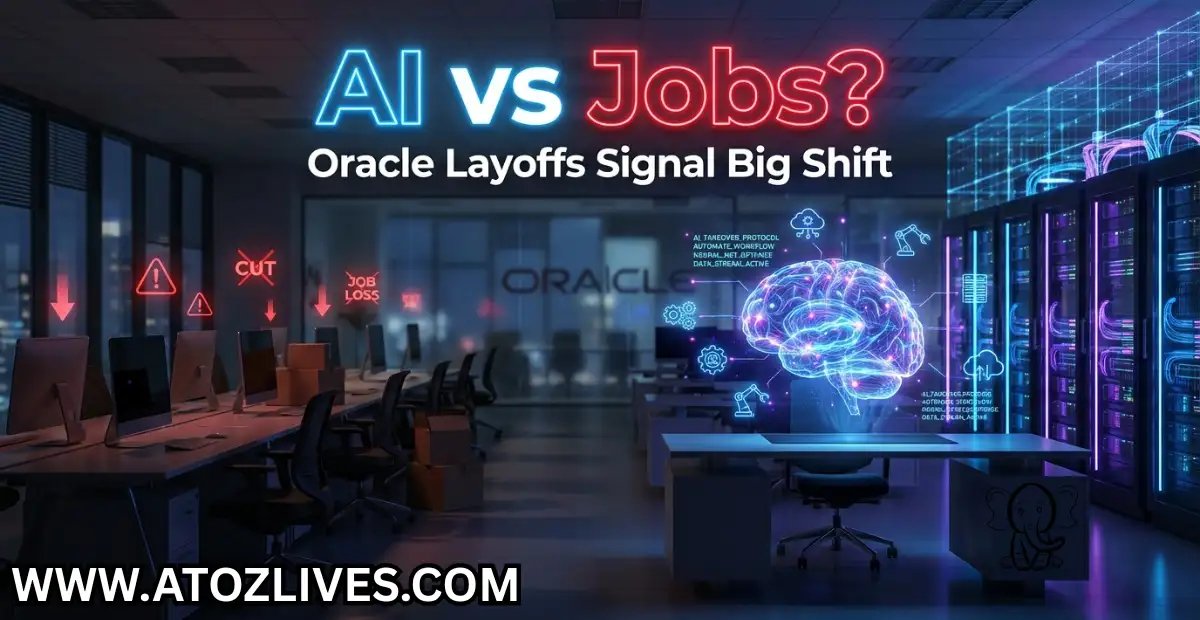
Job Cuts Reflect Shift Toward AI Investments
Oracle has begun a major round of layoffs affecting thousands of employees globally, signaling a significant shift in the company’s priorities toward artificial intelligence and cloud infrastructure.
Reports indicate that the job cuts are part of a broader restructuring plan aimed at freeing up resources for large-scale AI investments.
The layoffs have impacted multiple departments, including cloud operations and enterprise software teams. In several cases, employees were informed through early morning emails with some being asked to exit immediately as part of the restructuring process.
Industry observers note that the move is closely tied to Oracle’s aggressive push into AI infrastructure, including massive spending on data centers and cloud capabilities.
The company is reportedly investing billions of dollars to strengthen its position in the rapidly evolving AI driven tech landscape.
Wider Industry Trend Raises Concerns for Workforce
Oracle’s decision reflects a broader trend across the technology sector where companies are increasingly prioritizing artificial intelligence over traditional software roles.
In 2026 alone, dozens of tech firms have already cut tens of thousands of jobs as they restructure to align with AI focused strategies.
Experts warn that this shift could reshape the employment landscape in the software industry. Roles that were once considered stable are now being re evaluated as automation and AI driven systems become more capable.
While companies argue that such changes are necessary for long term competitiveness, they also raise concerns about job security and the future of work.
At the same time, some analysts point out that AI investments may eventually create new types of jobs, particularly in areas like machine learning, data engineering and advanced computing.
However, the transition is unlikely to be smooth, as workers may need to reskill to remain relevant in an evolving industry.
Oracle has not issued a detailed public statement on the layoffs but the move underscores a growing reality: as companies race to adopt AI, the traditional software workforce is facing increasing uncertainty.