

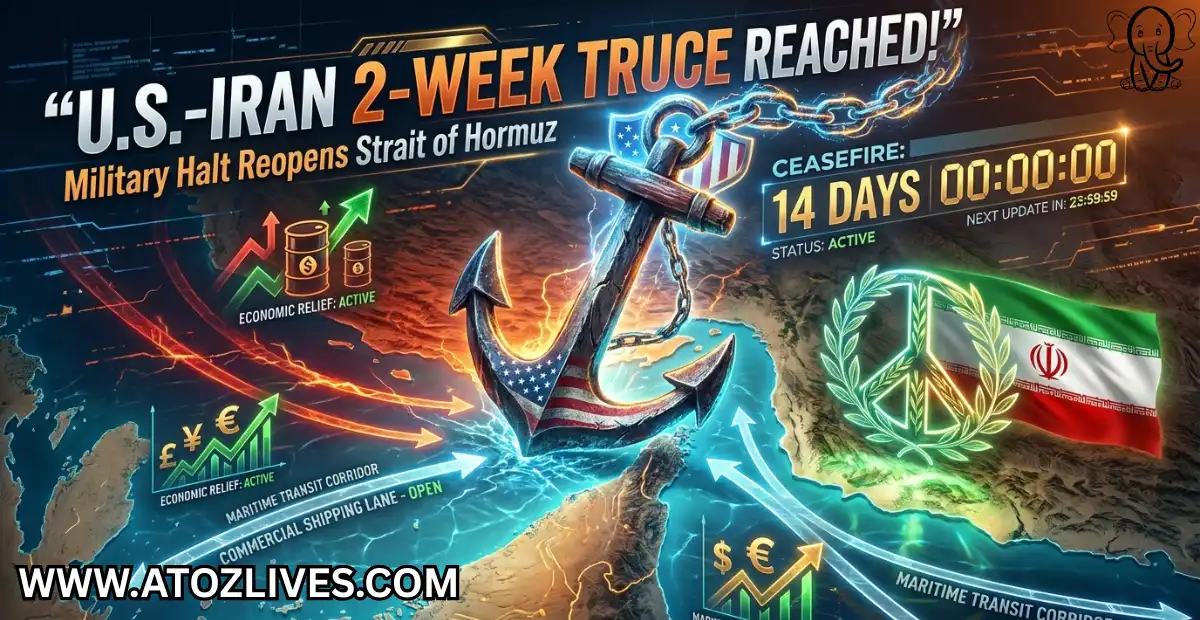
In a significant diplomatic breakthrough that has sent shockwaves through global markets, the United States and Iran have officially agreed to a two week ceasefire. U.S. Iran Ceasefire 2026.
The deal, announced late Tuesday, comes after forty days of intensifying conflict and just ninety minutes before a critical U.S. deadline was set to expire.
Mediated largely by Pakistan, the temporary truce aims to halt offensive military operations and provide a necessary window for high level negotiations.
As part of the immediate terms, Tehran has signaled it will allow the reopening of the Strait of Hormuz, a vital artery for the world’s energy supply which had been effectively closed since late February.
The agreement has already had an immediate impact on the global economy with oil prices experiencing a record breaking plunge as the threat of a full scale energy crisis recedes.
President Donald Trump confirmed the suspension of planned strikes on Iranian infrastructure, describing the move as a “double sided ceasefire” designed to test the viability of a long term peace framework.
However, officials from Iran’s Supreme National Security Council were quick to clarify that this pause does not signify a formal end to the war.
Instead, it serves as a tactical window to review a 10 point peace proposal that includes demands for sanctions relief and the unfreezing of Iranian assets.
Islamabad to Host Critical Peace Talks This Friday
With the guns falling silent for the moment, the diplomatic focus shifts to Islamabad, Pakistan, where delegations from both Washington and Tehran are scheduled to meet this Friday.
Pakistani Prime Minister Shehbaz Sharif who played a central role in brokering the “Islamabad Accord,” stated that the ceasefire is intended to cover multiple theaters of conflict, including Lebanon.
The goal of these upcoming sessions is to transform the fragile 14 day pause into a permanent cessation of hostilities. While the U.S. views the reopening of the Strait of Hormuz as the primary benchmark for success, Iran is pushing for a binding resolution that ensures its long term economic and territorial security.
Global Markets React as the Strait of Hormuz Reopens
The strategic importance of this ceasefire cannot be overstated, as it directly addresses the maritime blockade that had brought global shipping to a standstill.
For the first time in weeks, safe passage through the Persian Gulf is being coordinated, albeit under the watchful eye of the Iranian Armed Forces. International observers remain cautiously optimistic but warn that the situation is incredibly fluid.
With military assets still positioned across the region and deep seated distrust remaining on both sides, the next fourteen days will determine whether this is a genuine turning point in U.S. Iran relations or merely a brief interruption in an ongoing regional struggle.