
If you are a US business owner who deployed a chatbot between 2023 and 2025, we need to have a difficult conversation.
That “helpful” AI assistant you launched the one that answers FAQs and costs you thousands in API tokens every month is likely burning a hole in your budget.
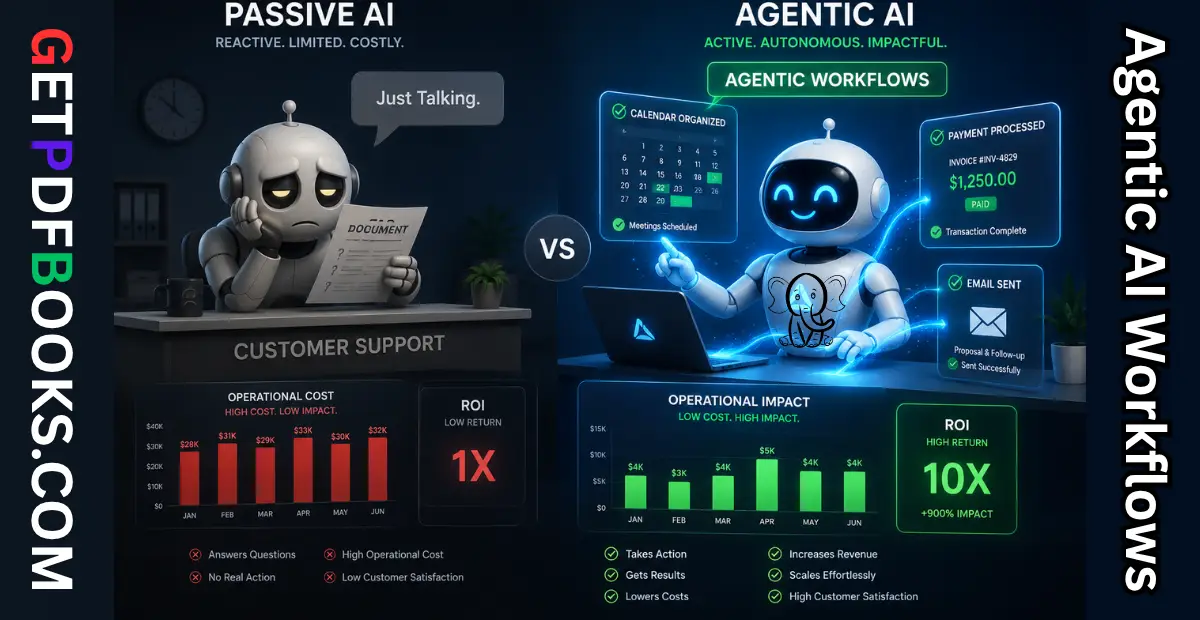
While the initial promise of ChatGPT was automated customer delight, the reality for many in 2026 is that chatbots are passive cost centers.
They have become the digital watercooler: polite, chatty but ultimately unproductive.
But the technology didn’t fail. It evolved. The age of the conversational chatbot is over; the era of Agentic AI has arrived.
For American businesses looking to transition from cost to profit, understanding this shift is the single most important tech decision of this decade.
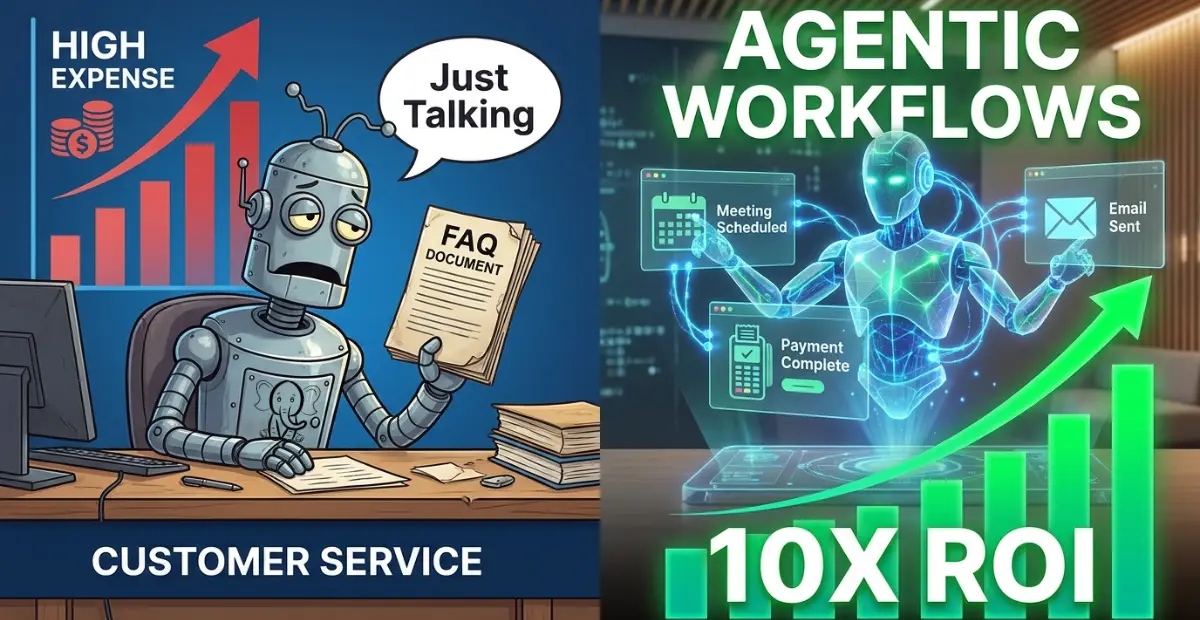
Here is why your chatbot is failing and the exact roadmap for transitioning to Agentic Workflows that generate 10x ROI.
Part 1: The Problem with ‘Chatty’ Bots (The Passive Cost Center)
To understand why chatbots fail, we must look at how they work. Most legacy chatbots are built on a simple premise: User Ask, AI Answers.
They are information repositories. If a customer asks, “What is your refund policy?” the bot answers. It works well for simple knowledge retrieval but it has three major flaws in a high efficiency market like the US.
1. It creates more work, not less.
A traditional chatbot rarely solves the problem completely. If the user’s question is complex, the bot usually ends up escalating the issue to a human.
This means you are now paying for the bot and the human agent, creating a double cost.
2. The Token Burn Rate.
In 2025, API token costs for running advanced models (like GPT-4) were significant. When customers “chat” aimlessly, they are burning your budget with every word.
Most chatbots generate high interaction counts but very low transactional value.
3. Zero Proactivity.
A standard chatbot is reactive. It sits. Chatbot waits to be spoken to. It doesn’t analyze user behavior to see that a customer is stuck on the checkout page and proactively offer a conversion boosting solution.
Are You Ready To Get Paid To Review Apps On Your Phone Then Try It…
Part 2: What is Agentic AI? (The Solution)
Imagine the difference between a new intern and a veteran Operations Manager.
-
The intern (your current chatbot) can find documents and answer basic questions when asked.
-
The Operations Manager (Agentic AI) understands the goal (“Increase Q3 sales”) and proactively decides which steps to take, which tools to use and when to take action to achieve it.
Agentic AI isn’t designed to chat; it’s designed to act.
An AI “Agent” is a persistent program that combines large language models (the “brain”) with tool use capabilities. When you give an Agent a goal, it can:
-
Analyze the request.
-
Plan a multi step execution strategy.
-
Use external APIs (like checking Shopify inventory, sending an email via SendGrid or processing a payment via Stripe).
-
Monitor its own work for errors.
-
Deliver a final, completed task, not a paragraph of text.
Part 3: Why This is a 10x ROI Shift for US Businesses
This transition changes AI from a line item on your expense report to your most profitable employee.
The Old ROI (Chatbot): Cost Reduction
At best, a chatbot reduces some customer service hours. ROI is perhaps 1.2x.
The New ROI (Agentic): Revenue Generation
Agentic Workflows actively generate revenue and massive operational efficiency. ROI is 10x or more.
How to Start a Blog in 2025: A Step-by-Step Guide for Beginners
Scenario: The Delayed Shipment
-
Old Chatbot Approach (Cost: $0.80/interaction): Customer asks, “Where is my order?” Bot: Here is the status page for your order: #12345. Let me know if you need help!
-
Result: The customer still has to go click the link, and still feels anxious. No money was made. Time was marginally saved.
-
-
New Agentic Approach (Cost: $1.20/execution): Customer asks, “Where is my order?”
-
The Agent identifies this as a shipping delay.
-
It uses an API tool to check the carrier’s real time status.
-
It finds that the order is delayed due to weather in Chicago.
-
It automatically generates and sends a personalized email to the customer explaining the delay and offering a $5 coupon for their next purchase (using the Shopify API).
-
It responds on chat: “Your order #12345 is in Chicago but delayed 1 day due to weather. We are sorry! I just emailed you a $5 coupon code for your next order to make up for the wait.”
-
Result: A fully resolved issue. Increased customer delight. Guaranteed future revenue via the coupon. This is a revenue generating workflow.
-
Part 4: Your Roadmap to Transition (Step-by-Step)
You cannot switch to Agentic AI overnight but you can start today. Here is the framework we use to transition clients in the USA.
Step 1: Conduct an AI Workflow Audit
Identify where your current chatbot spends 80% of its time. Is it simple FAQs (“When do you close?”)? Or are these transactional blockers (“I can’t reset my password”)?
You are looking for high volume, low complexity tasks that are currently “reactive.”
Step 2: Swap the ‘Chat First’ Model for a ‘Task First’ Model
Change the user interface from a generic text box to structured “Task Selection.”
Instead of: “How can I help you today?” Use: “What would you like me to do? [1. Process a Refund] [2. Track my Order] [3. Schedule a Consultation] [4. Other]”
When the user selects an option, a dedicated Agentic Workflow begins, minimizing wasteful API tokens.
Are You Excited To Read More about AI Then Click Here…
Step 3: Implement Tool-Use (The Missing Link)
This is the most critical step. Your AI must be given access to your business tools. This usually means building simple API connectors that allow the AI to “read” and “write” to your critical databases (Salesforce, Airtree, Shopify, Google Calendar).
Step 4: Define Goal-Based Instructions (agent_workflows.txt)
Instead of just a prompt, you create a text based “instruction set” for each agent.
-
Example Agent instruction: “You are the Booking Agent. The goal is to book a qualified consultation. A client is only qualified if they are based in the USA and have a budget over $5k. Your process: 1. Confirm location. 2. Ask budget. 3. If qualified, use the Calendly API tool to book a slot. 4. If not qualified, thank them and close the chat.”
The Executive Verdict: Passive is Over. Active is Now.
In the fast moving economy of 2026, you cannot afford a team even a digital one that simply sits and talks. Every element of your business must be an active contributor to the bottom line.
Your chatbot isn’t failing you because AI isn’t ready. It is failing you because it was never designed for agency.
The transition to Agentic AI Workflows is the most potent lever you can pull right now. It is the definitive shift from burning cash on conversations to fueling a highly profitable, autonomous business engine.
The businesses that make this move in 2026 will dominate. Those that remain “just talking” will vanish.
Want To Get Online Cash…
FAQ
1. Is “Agentic AI” just another buzzword?
No. It is a fundamental shift in technology. Traditional AI (Generative) creates content. Agentic AI is designed to use tools, make decisions and execute multi step tasks without human oversight.
2. How much does transitioning to Agentic Workflows cost?
The complexity of the transition depends on your existing tech stack.
While initial integration can cost between $5k and $25k for custom development, the operational cost (API tokens) decreases significantly because agents are goal driven and produce less “chat waste.”
3. What is the biggest difference between a regular chatbot and an Agentic Workflow?
Action. A chatbot answers. An Agent does. A chatbot says, “I found your order.” An Agent finds the order, updates the status, emails the client a coupon and resolves the ticket.
4. What industries in the US are adopting Agentic AI first?
The lead adopters are in high transaction, digital first industries: Luxury Real Estate (PropTech), E commerce (customer resolution), B2B Tech Startups (sales qualification) and US Healthcare (appointment scheduling and patient intake).
Are You Using Facebook, Twitter and YouTube (Get Paid To Use)
5. How do Agentic Workflows impact human jobs?
It is an augmentation not a replacement. Agentic AI takes over the boring, repetitive, low level operational tasks ( ooking meetings, processing simple refunds).
This allows your valuable human employees to focus on complex strategy, relationship building and creative problem solving.
6. Can Agentic AI use my company’s internal tools like Salesforce or Shopify?
Yes, that is the entire purpose. The core of Agentic AI is “Tool Use.” Developers create secure API connectors that allow the AI “brain” to read and write to your private systems.
7. Is Agentic AI safe from data leaks?
Security is the most important part of any deployment. We build Agentic Workflows that operate within your established security protocols (like OAuth) and often use Identity Locked AI to ensure that data is only accessed by authenticated users.
8. Can I use existing platforms like ChatGPT for Agentic Workflows?
Yes, but with limitations. You can build simple agents using “OpenAI GPTs,” but for complex, secure, enterprise level agentic workflows, businesses typically use specialized tools (like LangChain or AutoGen) integrated directly into their backend.
9. How do you measure the ROI of Agentic Workflows?
You measure it by task resolution. Calculate how many minutes a human used to take to resolve a task (tracking an order, qualification).
Compare that to the execution cost of the agent. Most workflows show an 80-90% operational cost reduction and often include a revenue generation lift.
10. What is the first step I should take?
Audit your current chatbot’s logs. Find the 1-3 tasks that waste the most time and are the most predictable (basic sales pre qualification). This is where your first Agentic Workflow should be deployed.
“Live Chat Jobs – You have to try this one”
Ready to Begin?
➜ Click Here to explore top-rated affiliate programs on ClickBank!
➜ Reach Our Free Offers: “Come Here To Earn Money By Your Mobile Easily in 2026.”
Want To Read More Then Click Here…
If You Are Interested In Health And Fitness Articles Then Click Here.
If You Are Interested In Indian Share Market Articles Then Click Here.
To convert images 100% free, you always use Image Converter Online .
Thanks To Visit Our Website-We Will Wait For You Come Again Soon…