
Starting an online business in 2026 can feel confusing because there are more opportunities than ever.
AI tools have made it possible for one person to provide services that previously required a larger team, while freelancing remains one of the simplest ways to sell a skill directly to clients.
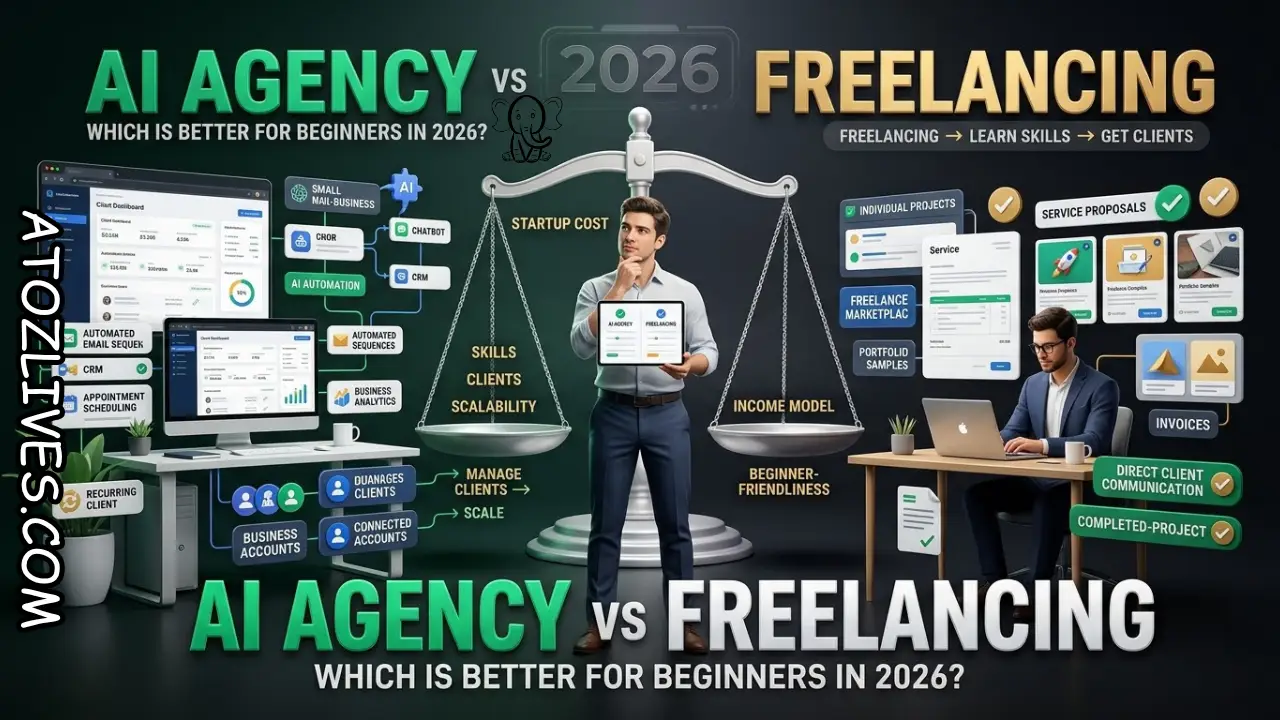
Two models are attracting particular attention: AI agencies and freelancing.
Both can be started with relatively low overhead, both can use artificial intelligence to improve productivity, and both can eventually become serious businesses. But they are not the same thing.
Freelancing usually means selling your own time and expertise directly to clients.
An AI agency is generally more focused on delivering a business outcome through AI tools, automation, systems, and sometimes a team of people or contractors.
The choice matters because a beginner can waste months trying to build an agency before learning how to sell or deliver a basic service.
At the same time, someone who stays a freelancer forever may miss the opportunity to create systems and recurring revenue.
The good news is that you do not necessarily have to choose one model permanently. A beginner can start as a freelancer, learn what businesses actually need, and gradually turn a proven service into an AI-powered agency.
Are You Ready To Get Paid To Review Apps On Your Phone Then Try It…
AI Agency vs Freelancing: What Is the Real Difference in 2026?
The simplest distinction is this: a freelancer usually sells a service personally, while an agency sells a solution or service that can be delivered through systems, processes, technology, and potentially multiple people.
For example, a freelance writer might charge a client to produce four articles each month. The freelancer personally researches, writes, edits, and delivers those articles.
An AI agency might instead sell a complete content system that includes topic research, AI-assisted drafting, human editing, SEO optimization, publishing, and reporting.
The difference is not simply whether AI is being used. A freelancer can use AI extensively and still operate as a freelancer. Likewise, an agency can use conventional software and human workers.
The business model is determined more by how the service is packaged, sold, and delivered.
This distinction is becoming more important because AI is moving into ordinary business operations.
The U.S. Census Bureau reported that business AI use remained around 17% to 20% during its December 2025 through May 2026 measurement period, while expectations for future use were higher.
Small businesses are also experimenting with AI for practical functions such as productivity, marketing, written communication, customer service, design, analytics, and programming.
The Federal Reserve Bank of San Francisco reported that nearly 40% of small-business respondents in its 2024 survey said they were already using or planning to use AI.
That creates opportunities for both freelancers and agencies. Businesses may need someone to perform a specific task, or they may need someone to design and manage a broader AI-enabled workflow.
The beginner’s challenge is determining which level of service they can realistically deliver.
How to Start a Blog in 2025: A Step-by-Step Guide for Beginners
Why Freelancing Is Usually Easier for a Beginner to Start
Freelancing has one major advantage: simplicity. You can start with a skill you already have, identify a customer who needs that skill, and sell a clearly defined service.
You do not need a complicated brand, a large team, or an elaborate operational system.
A beginner could offer services such as content editing, social media management, video editing, graphic design, virtual assistance, research, presentation design, lead research, website updates, or AI-assisted content production.
The important part is not having dozens of services. It is being able to deliver one useful service consistently.
Freelancing also gives you direct exposure to customer problems. This is extremely valuable for someone who eventually wants to build an AI agency.
After working with several clients, you may notice that businesses repeatedly struggle with the same tasks, such as creating marketing content, responding to customer inquiries, organizing leads, or producing reports.
Those repeated problems can become the foundation of an agency offer. Instead of guessing what businesses want, you have real experience showing you what they are willing to pay for.
Current research also suggests that skilled freelancing is not disappearing because of AI.
Upwork’s 2026 Future Workforce Index reported that the share of skilled U.S. knowledge workers who freelance rose from 28% to 38% in one year, while the company emphasized the growing value of judgment-driven work.
That is important for beginners. You do not have to compete with AI by pretending you can do everything manually.
Instead, you can use AI to complete work faster while selling your judgment, communication, quality control, industry knowledge, and ability to understand the client’s actual goal.
Are You Excited To Read about AI Then Click Here…
When an AI Agency Can Become Better Than Traditional Freelancing
An AI agency becomes attractive when you can solve a repeatable business problem rather than simply complete individual tasks.
Instead of selling “10 social media posts,” you might sell an AI-assisted content system that plans, creates, reviews, schedules, and reports on a company’s monthly social content.
The agency model can also make it easier to increase capacity. A freelancer is often limited by personal time. If you have ten clients and each requires several hours of work, eventually your schedule becomes the bottleneck.
An agency can use documented processes, automation, contractors, or employees to handle parts of delivery.
Recurring services are another major advantage. An agency can create monthly packages around marketing automation, customer-service workflows, AI content systems, lead management, reporting, or other business processes.
Recurring work can make revenue more predictable than constantly searching for individual projects.
However, an agency is not automatically more profitable. More complexity means more responsibility.
You may need to manage contractors, quality control, customer expectations, software subscriptions, data security, contracts, revisions, and technical problems.
The current AI environment makes the opportunity interesting because many businesses are adopting AI without necessarily having the expertise to implement it effectively.
Upwork‘s 2026 research on SMBs found that business leaders were actively exploring AI agents, while productivity gains remained incremental rather than universally transformative.
That gap is where a capable agency can create value. The business does not necessarily want “AI.”
It wants fewer repetitive tasks, faster work, better customer communication, more leads, improved marketing, or lower operational friction. An agency succeeds when it connects the technology to that business outcome.
Want To Get Online Cash…
AI Agency vs Freelancing: Which One Requires Less Money and Risk?
For most beginners, freelancing generally requires less money to start. If you already have a computer, internet connection, and a marketable skill, your initial costs can be relatively low.
You may need software subscriptions, a portfolio, communication tools, or marketplace fees, but you can keep the operation simple.
An AI agency can also be started cheaply, especially when the founder performs the work personally. The problem is that agencies often encourage beginners to purchase too many tools before they have customers.
Paying for multiple AI platforms, automation systems, CRMs, design tools, domains, and other subscriptions does not create revenue by itself.
The safest approach is to sell first and build around a real customer problem. If a client pays for an automation project, you can use the necessary tools to deliver it.
If a content client needs a particular workflow, you can adopt the software that genuinely improves the process.
Risk also increases when an agency promises services it cannot reliably deliver.
A beginner might sell an advanced AI chatbot, autonomous agent system, or complex business automation without understanding APIs, data security, integrations, error handling, or maintenance requirements.
That can create expensive problems. AI systems can produce incorrect information, fail when an external application changes, or behave differently from what the client expects.
More sophisticated systems therefore require testing, monitoring, documentation, and human oversight.
Financial and tax responsibilities also matter. If you earn money as a freelancer or independent contractor in the United States, the IRS generally treats that income as taxable.
The IRS says net self-employment earnings of $400 or more from gig work can trigger a federal filing requirement, even when the work is only part-time.
You can use it for mental peace and balance.
Which Model Is Easier to Scale and Make More Money?
Freelancing can scale financially, but personal time eventually becomes an important limitation. You can raise rates, specialize in a valuable niche, create packages, improve efficiency, and build recurring contracts.
However, if every additional dollar requires additional hours from you, there is a ceiling.
An agency attempts to break that relationship between revenue and the founder’s personal working hours. Processes can be documented, repetitive work can be automated, and selected tasks can be delegated.
The founder can increasingly focus on sales, strategy, client relationships, and quality control.
That does not mean an agency has unlimited scalability. An agency still has delivery costs. Contractors need to be paid, software has costs, clients require support, and quality can decline if growth happens faster than the operational system can handle.
The most realistic progression for a beginner is often freelancer first, agency second. Start by selling one service. Learn how to find customers.
Deliver the service yourself. Understand the problems clients repeatedly encounter. Then identify which portions can be automated or delegated.
For example, imagine you begin by managing social media content for three local businesses. You notice that all three need monthly content calendars, caption creation, image resizing, scheduling, and performance summaries.
You develop a repeatable workflow using AI and automation tools. Eventually, you can package that system as a monthly service and bring in another person to handle routine production.
That is a genuine transition from freelancing to an agency. You are not simply changing the word in your business name. You are building a repeatable delivery system around a problem that customers have already demonstrated they will pay to solve.
The Best AI Agency Ideas for Beginners in 2026
One of the most accessible agency opportunities is AI-assisted content production. Small businesses need website content, social posts, emails, newsletters, product descriptions, and marketing materials, but many do not have an internal content team.
An agency can combine AI-assisted production with human editing and business-specific strategy.
Another possibility is AI customer-support assistance. A business may have hundreds of repetitive customer questions about products, appointments, policies, or basic troubleshooting.
An agency can help organize the company’s approved information and build a system that assists employees or customers while keeping appropriate human review.
Lead-management automation is another practical area. A small business may lose potential customers because inquiries arrive through multiple channels and follow-up is inconsistent.
An agency can help organize lead information, create reminders, classify inquiries, and automate routine communications without trying to replace the sales team.
AI research and reporting can also become a service. Businesses may need competitor monitoring, customer-review analysis, market research, or recurring summaries.
AI can speed up information organization, while the agency provides human verification and turns raw information into something the client can use.
The important point is to avoid building an agency around a vague promise such as “we provide AI solutions.” That phrase does not tell a business owner what they are buying.
A better offer is specific: “We build AI-assisted customer-support systems for small e-commerce businesses” or “We automate lead follow-up for local service companies.”
Current small-business research supports focusing on practical business functions rather than AI for its own sake.
The San Francisco Fed found that small businesses were using or considering AI across productivity, marketing, communication, customer service, analytics, and other functions.
You can use it to be healthy and fit forever.
AI Agency vs Freelancing: The Best Choice for a Beginner in 2026
For most complete beginners, freelancing is the better place to start. It has fewer moving parts, requires less operational knowledge, and lets you learn directly from paying customers.
You can test an offer without building a large business infrastructure.
An AI agency becomes more attractive after you have evidence that customers want a particular service. Once you know what clients repeatedly ask for, you can turn that service into a standardized package.
AI and automation can then help you deliver the package more efficiently.
There is also a middle ground: the solo AI freelancer. This person operates independently but uses AI heavily to increase productivity.
You might call yourself an AI automation freelancer, AI content specialist, AI research consultant, or AI marketing specialist without immediately building a traditional agency.
This hybrid approach can be particularly practical in 2026. AI allows one person to perform more work, but businesses still value human judgment.
The U.S. Chamber of Commerce Foundation reported in 2026 that small-business workers were largely using AI to increase productivity rather than simply eliminate their own jobs.
The best choice therefore depends on your current position. If you have no clients, no proven service, and limited business experience, start freelancing.
If you already have recurring clients and a repeatable process, consider turning that process into an agency.
Do not build an agency simply because the word sounds more impressive. Build one when the business model genuinely requires systems, delegation, automation, or a team.
Until then, a well-run freelance business can be simpler, more profitable, and easier to control.
Conclusion
The AI agency vs freelancing debate does not have one universal winner. For a complete beginner in 2026, freelancing is usually the more practical starting point because it is simpler, cheaper, and provides direct experience with real customers.
An AI agency becomes more attractive when you discover a repeatable problem that businesses are willing to pay you to solve.
At that point, AI, automation, documented processes, and additional workers can help you serve more clients without personally doing every task.
The biggest opportunity is not simply “starting an AI business.” It is finding a real business problem and using AI to solve it more efficiently than the client could solve it alone.
The current U.S. market gives beginners a reason to explore this space. Business AI adoption continues to expand, small businesses are experimenting with practical applications, and skilled freelancing remains a significant part of the U.S. workforce.
If you have no experience, start small. Pick one service, one customer type, and one problem. Get your first clients. Learn what they actually value. Then build systems around what works.
Freelancing can teach you the market. An AI agency can eventually help you scale what you have learned.
You can try it to save homes from the energy crisis and reduce electricity bills.
FAQs
1. Is freelancing or an AI agency better for beginners?
Freelancing is generally easier for a beginner because you can start with one skill and one service. An AI agency usually makes more sense after you understand customer needs and have a repeatable service.
2. Can I start an AI agency without coding?
Yes, depending on the service. Content systems, marketing workflows, research, certain no-code automations, and AI-assisted business services can be offered without traditional programming. More complex integrations may require technical expertise.
3. Is an AI agency more profitable than freelancing?
Not automatically. Agencies can potentially scale beyond the founder’s personal hours, but they also have higher management, delivery, software, and quality-control responsibilities.
4. Can a freelancer use AI?
Absolutely. Using AI does not automatically turn a freelancer into an agency. A freelancer can use AI for research, drafting, analysis, organization, automation, and other tasks while remaining responsible for the final work.
5. What is the easiest AI service to sell as a beginner?
There is no single best service, but AI-assisted content editing, social media support, research, basic automation, and document creation can be practical starting points if you have the relevant skills.
6. How do I turn freelancing into an AI agency?
Start by identifying a service clients repeatedly purchase. Document your process, identify repetitive steps, introduce appropriate AI and automation, standardize the offer, and eventually delegate parts of delivery.
7. Do I need employees to call my business an AI agency?
No. The term “agency” is used broadly. However, simply adding “agency” to your business name does not create an agency model. What matters is how you sell and deliver the service.
8. Can I make money with AI without creating an AI agency?
Yes. Freelancing, consulting, digital services, content production, research, and other businesses can use AI to improve productivity without becoming an agency.
9. Is AI freelancing still worth starting in 2026?
It can be. Upwork’s 2026 research indicates that skilled freelancing is growing while AI is changing which types of work command value. Human judgment, specialized expertise, and outcome-focused services remain important.
10. What is the biggest mistake beginners make with AI businesses?
Trying to sell technology instead of solving a business problem. Clients usually care more about saving time, generating leads, improving customer service, reducing repetitive work, or producing better marketing than about which AI tool you use.
“Live Chat Jobs – You have to try this one”
Ready to Begin?
➜ Click Here to explore top-rated affiliate programs on ClickBank!
➜ Reach Our Free Offers: “Come Here To Earn Money By Your Mobile Easily in 2025.”
Want To Read More Then Click Here…
If You Are Interested In Health And Fitness Articles Then Click Here.
If You Are Interested In Indian Share Market Articles Then Click Here.
Thanks To Visit Our Website-We Will Wait For You Come Again Soon…