
I still remember the late-night panic of sitting staring at a massive, messy project board for a high-paying corporate client while trying to manually update tracking sheets, sync client communication channels and manage deliverables across three separate tools.
The client was paying thousands of dollars a month, but my time was evaporating into administrative black holes. It was exhausting.
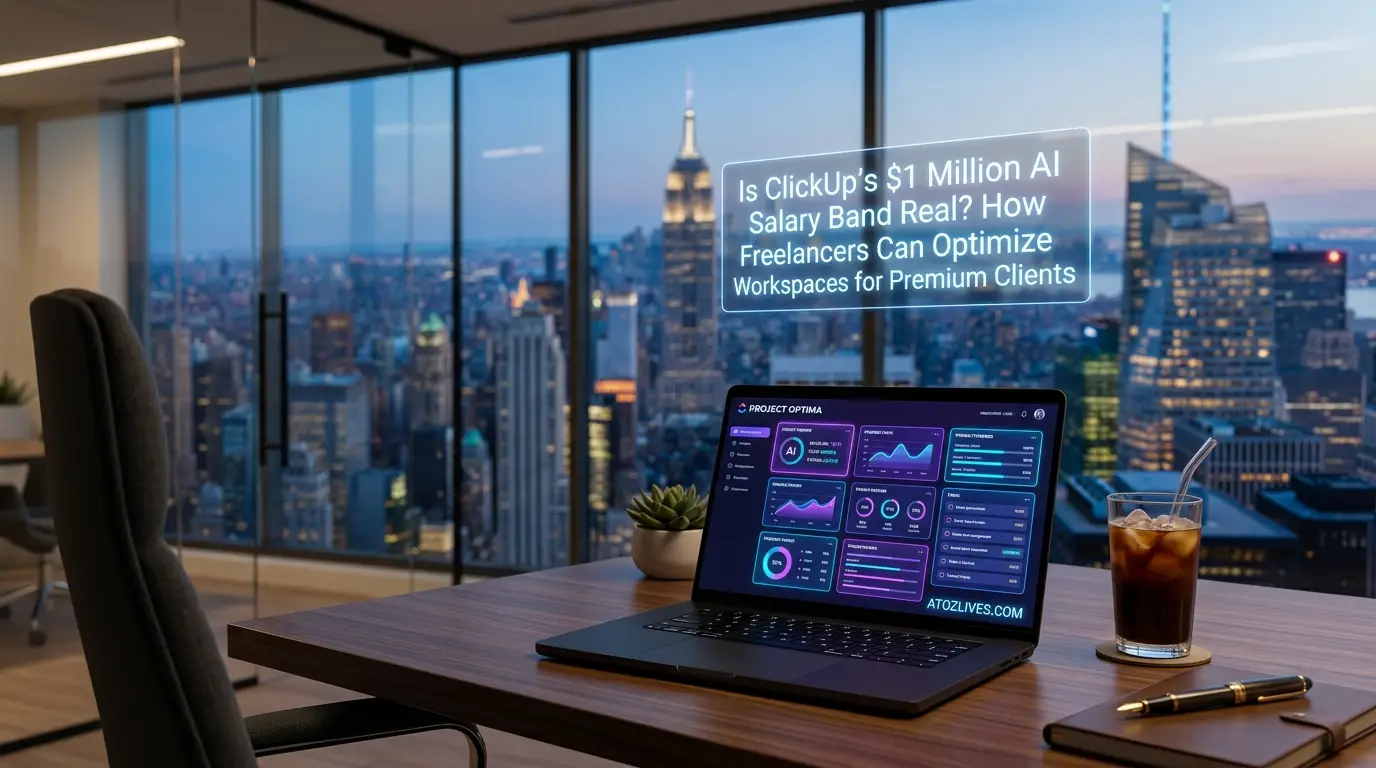
Then, a massive shift rocked the tech world. ClickUp, a giant in the productivity software space, laid off 22% of its workforce and replaced those traditional roles with an army of 3,000 autonomous AI agents.
The move created a stunning 3 to 1 ratio of digital agents to human employees. But what really set the internet on fire was the announcement by ClickUp CEO Zeb Evans.
He announced that the company is introducing a staggering $1 million cash per year salary band for remaining team members who can generate massive value by building and orchestrating these AI systems.
This news is not just a corporate data point; it is a clear roadmap for independent professionals.
Are You Ready To Get Paid To Review Apps On Your Phone Then Try It…
If an enterprise software company is willing to pay seven figures to internal team members who manage digital systems rather than do manual work, premium clients in the open market will pay top dollar to freelancers who can bring that exact level of operational efficiency to their businesses.
The era of trading raw hours for basic administrative execution is ending.
To land and retain enterprise-level accounts that pay premium retainers, you must transform from a simple service provider into an operations engineer.
That means organizing your workspaces, deploying autonomous automation and building systems that prove you can handle high-level scale.
THE NEW TECH PARADIGM (2026)
Traditional Workforce – 22% Corporate Headcount Cut
Operational Engine – 3,000 Internal AI Agents
Top Talent Reward – $1,000,000 Annual Salary Band
Demystifying the Million-Dollar AI Compensation Structure
When people see a headline about a million-dollar base salary at a software company, the immediate reaction is skepticism. It sounds like a marketing stunt or a recruiting gimmick designed to grab headlines during a period of corporate downsizing.
However, looking closely at the mechanical details reveals a logical financial structure.
The company is dividing its remaining staff into three specific buckets: Builders who architect systems, System Managers who oversee automated workflows and Front-liners who handle direct, high-value human relationships.
The traditional middle-tier roles focused on repetitive data entry, basic scheduling and manual report generation have been entirely phased out.
The funds for these massive salary bands come directly from the savings generated by this structural shift. When a business replaces hundreds of traditional salaries with digital infrastructure, the operational overhead drops drastically.
The capital that used to go toward a large, slow-moving middle management tier is now concentrated on rewarding the small group of elite operators who keep the digital infrastructure running.
For independent consultants and freelancers, this is a massive validation. Enterprise clients are looking for external partners who understand how to operate within this high-efficiency framework.
They do not want to hire an extra hand just to move tasks around a board; they want an expert who sets up autonomous systems that run without constant supervision.
How to Start a Blog in 2026: A Step-by-Step Guide for Beginners
Why Premium Clients Pay for Ecosystems Rather Than Hours
High-value corporate clients do not buy your time. They do not care if you spend five hours or fifty hours on a project. What they are actually purchasing is peace of mind, risk mitigation and operational speed.
When a premium client looks at a freelancer who tracks billing by the minute and manually types out status updates every Friday, they see a liability. They see an old-school approach that cannot scale with their business needs.
Premium clients are looking for complete operational ecosystems. They want to walk into a shared digital space and immediately see clean data, automated progress updates and zero friction.
When you build a workspace that handles intake, processes data and coordinates communication automatically, you are modeling the exact internal efficiency that tech leaders are spending millions to achieve.
You stop being an expense on their balance sheet and become an indispensable strategic asset. You are no longer competing with low-cost labor on gig platforms because you are selling a modern, systematic result that traditional freelancers cannot match.
Architecting the Perfect Workspace Strategy for Enterprise Accounts
To attract clients with massive budgets, your shared project environments must look and feel like an elite enterprise operation. A messy, confusing setup with vague task descriptions and missing deadlines will instantly kill client trust.
Are You Excited To Read about AI Then Click Here…
The initial blueprint must prioritize extreme clarity and absolute scannability.
Client Intake Portal
Automated Discovery – (Auto-Populates Client Strategy Board)
Centralized Resource Hub – (Houses Contracts, Assets & Invoices)
Designing a Seamless Onboarding Experience
The relationship with a high-paying client is often won or lost during the first forty-eight hours after signing a contract. A chaotic onboarding process creates immediate buyer’s remorse.
Your environment should have a dedicated, locked client portal that acts as a single source of truth.
The moment a client logs in, they should see a personalized welcome dashboard containing their contract, project scope, visual milestones and real-time project metrics.
By eliminating the need for them to dig through long email threads to find a file or check a date, you establish an elite standard of professionalism right away.
The layout must be clean, utilizing minimalist design principles and clear color-coded statuses to guide their eyes effortlessly to critical data.
Implementing Deep Functional Hierarchy
A common mistake made when setting up digital workspaces is creating a flat structure where everything is dumped into a single long list. High-paying accounts require deep functional organization.
Separate your environment into high-level strategy views for executives and detailed execution views for project teams. Use folders, custom lists and distinct tags to categorize work by phase, department or priority level.
Enterprise Space
1. Strategic Executive Overview
Macro Milestones & KPI Tracking
2. Tactical Execution Tracks
Asset Creation & Content Pipelines
Technical System Automations
This deep hierarchy ensures that an executive can jump into the dashboard, glance at a high-level chart and understand the health of the project in under ten seconds without getting overwhelmed by daily micro-tasks.
Want To Get Online Cash…
Driving Project Velocity with Agentic Automation
To match the performance standards of a modern, tech-driven marketplace, you cannot rely on manual effort to keep your projects moving forward.
You must implement automation that acts as an invisible project manager, constantly updating records, notifying team members and preparing assets in the background.
| Automation Layer | Manual Action Replaced | Client Value Delivered |
| Intake Pipeline | Copying form data into project tasks | Instant project kickoff with zero delay |
| Status Engine | Emailing clients to say a task is finished | Real-time visibility and absolute trust |
| Handoff Trigger | Sending manual notifications to designers | Maximum velocity across project phases |
| Archival System | Creating backup folders and sorting files | Flawless documentation and asset security |
Setting Up Cross-Functional Triggers
Every repetitive action in your workspace is a threat to your profitability. Build automated rules that connect different stages of your workflow together seamlessly.
For instance, when a content piece moves to the “Client Review” status, the system should automatically generate a secure feedback link, assign a review task to the client with a specific deadline and send an instant notification to their preferred communication channel.
When the client approves the asset, the system should immediately change the task status, assign it to your technical team for implementation and move the asset into a finalized delivery folder.
This rapid, hands-free handoff keeps project velocity exceptionally high.
Are You Using Facebook, Twitter and YouTube (Get Paid To Use)
Integrating Automated Status Reporting
Premium clients hate asking for status updates. If a client has to message you to ask how a project is going, your system has failed.
Use automated dashboards that compile task completion rates, milestone progressions and upcoming deadlines into clean visual charts.
Set up your workspace to automatically compile these metrics into a sleek, beautifully formatted summary report sent directly to the client at the exact same time every single week.
This consistent, automated transparency gives the client complete confidence that their investment is being handled with absolute precision, freeing you up to focus on high-level strategic delivery.
Perfecting the Human Touch in an Automated World
As software platforms deploy thousands of internal digital agents and automate traditional communication channels, an interesting counter-trend is emerging.
When the digital marketplace becomes saturated with automated messages and standardized responses, genuine human interaction becomes the ultimate luxury.
Zeb Evans highlighted this exact point, noting that in a world filled with automated communications, direct human connection matters more than anything to clients.
To reduce mental stress and relief from anxiety , you can try it.
The goal of optimizing your workspace and implementing deep automation is not to turn yourself into a cold, distant robot.
The real objective is to automate all the repetitive, low-value administrative tasks so you can redirect your time, energy and creativity into high-value human interaction.
When you do not have to spend hours managing spreadsheets, fixing broken tags or chasing down file links, you have the mental clarity to show up to strategy sessions fully present.
You can dive deep into your client’s long-term business goals, provide tailored strategic insights and build deep, long-lasting partnerships that go far beyond a simple transactional contract.
THE TIME REDISTRIBUTION ENGINE
[Old Way] Admin Work (80%) –> Client Strategy (20%)
[New Way] Automated (0%) –> CLIENT STRATEGY (100%)
Scaling Your Freelance Operation Without Increasing Headcount scale
The ultimate dream for any digital entrepreneur is to grow revenue without simultaneously blowing up overhead costs and management complexity.
In the traditional freelance model, scaling meant hiring virtual assistants, project managers and junior creators which immediately introduced hiring risks, training lag and massive management fatigue.
By building highly optimized, automated workspaces, you can scale your operational capacity entirely through software infrastructure.
Try it to improve gum health and prevents bleeding.
A single well-architected ecosystem can easily handle the administrative workload of an entire traditional agency team.
You can confidently take on multiple premium accounts at the same time, knowing that your automated intake pipelines, status triggers and reporting engines will keep every project running flawlessly on autopilot.
This allows you to maintain an incredibly lean operation with massive profit margins, putting you in the exact same league as the high-impact system managers pulling seven-figure salaries in the tech corporate world.
FAQs
1. Is the million dollar salary band at ClickUp a real base salary or is it tied entirely to performance bonuses?
The salary structure announced by CEO Zeb Evans includes a base cash compensation track that can reach up to $1 million per year. However, it is explicitly tied to extreme performance metrics.
To qualify for this compensation level, an employee must demonstrate a “100x impact” on the company’s operational efficiency by successfully building, deploying and orchestrating complex internal AI agent networks that replace massive amounts of traditional manual overhead.
2. How did ClickUp deploy 3,000 AI agents internally without breaking their existing workflows?
ClickUp approached this massive transition by acquiring the AI coding platform Codegen in late 2025 and restructuring their organizational chart into three clear, highly distinct tracks: Builders, System Managers and Front-liners.
The 3,000 internal AI agents operate as specialized digital workers that handle specific, repetitive tasks such as analyzing deep data, reviewing long meeting transcripts, managing cross-departmental task handoffs and monitoring system logs under the direct supervision of human system managers.
3. Do independent freelancers need to know how to code to build advanced workspace automations?
No, writing complex code is not a requirement to build highly optimized, automated systems for premium accounts. Modern project management platforms feature robust, intuitive visual automation builders that utilize conditional logic triggers, actions and targets.
The key skill is not writing traditional code; it is understanding business process mapping, structural data hierarchy and how to logically link different software platforms together to eliminate manual effort.
4. What are the specific visual styling elements that appeal most to premium enterprise clients?
Premium corporate clients respond incredibly well to workspaces that mirror high-end enterprise software aesthetics. This means avoiding messy, oversaturated color palettes and instead using minimalist design frameworks.
Focus on clean glassmorphism patterns, deep contrasting dark modes or crisp light modes, subtle grey or slate borders and highly consistent color-coded tags that match their corporate branding to create an immediate feeling of professional luxury.
To get relief from Knee,Hip and Back Pain use it.
5. How can an independent consultant convince a traditional client to switch to a shared workspace environment?
The best way to frame this transition is to present it as a massive benefit to their operational speed and clarity.
Position the shared workspace not as an extra app they have to learn but as an exclusive, high-value client portal that eliminates messy email chains, saves their executive team hours of review time and provides them with absolute, real-time transparency regarding their financial investment.
6. Will autonomous digital systems completely eliminate the need for human freelancers in the near future?
No, digital systems will not eliminate high-level human freelancers, but professionals who refuse to adapt to these new tools will certainly be replaced by operators who use them effectively.
AI excels at handling repetitive, high-volume data tasks and linear administrative workflows.
It cannot replicate deep strategic thinking, high-level creative problem-solving, empathetic client relationship management or the nuanced human touch required to navigate complex corporate challenges.
7. How often should automated progress reports be generated and sent out to high-ticket clients?
For standard premium accounts, a highly detailed, beautifully structured automated report should be generated once a week at an exact, predictable time, such as every Friday morning.
For fast-moving enterprise accounts with heavy budgets, you can supplement this with a live, real-time executive dashboard link embedded directly into their client portal, allowing stakeholders to check project health metrics whenever they need to without waiting for an email.
8. What is the most effective strategy for managing multiple premium accounts inside a single workspace safely?
To maintain complete data security and absolute client confidentiality, you must use strict workspace separation permissions. Create completely isolated folder ecosystems or individual private spaces for each account, ensuring that client teams can only see their own specific dashboards and assets.
Use a centralized, master operational space that only you can access to monitor your overall business velocity and manage your daily cross-client task priorities.
9. Can these advanced automation frameworks be applied effectively to creative fields like design or video production?
Absolutely. Creative fields benefit massively from operational automation. You can set up triggers that automatically generate structured asset delivery folders when a contract is signed, send instant proofing links to clients when a design file is uploaded, compile feedback annotations into actionable task descriptions and automatically optimize and archive asset files once final client approval is logged.
10. How can an independent professional accurately price an ecosystem setup for an enterprise organization?
When selling an optimized, automated ecosystem, you should avoid hourly pricing structures completely. Instead, utilize value-based pricing models that calculate the massive amount of time, manual labor and resource overhead your system will save their internal organization.
Frame the project cost around the long-term operational ROI and efficiency gains, allowing you to charge substantial, premium flat fees or high-ticket monthly management retainers.
“Live Chat Jobs – You have to try this one”
Ready to Begin?
➜ Click Here to explore top-rated affiliate programs on ClickBank!
➜ Reach Our Free Offers: “Come Here To Earn Money By Your Mobile Easily in 2025.”
Want To Read More Then Click Here…
If You Are Interested In Health And Fitness Articles Then Click Here.
If You Are Interested In Indian Share Market Articles Then Click Here.
Thanks To Visit Our Website-We Will Wait For You Come Again Soon…