
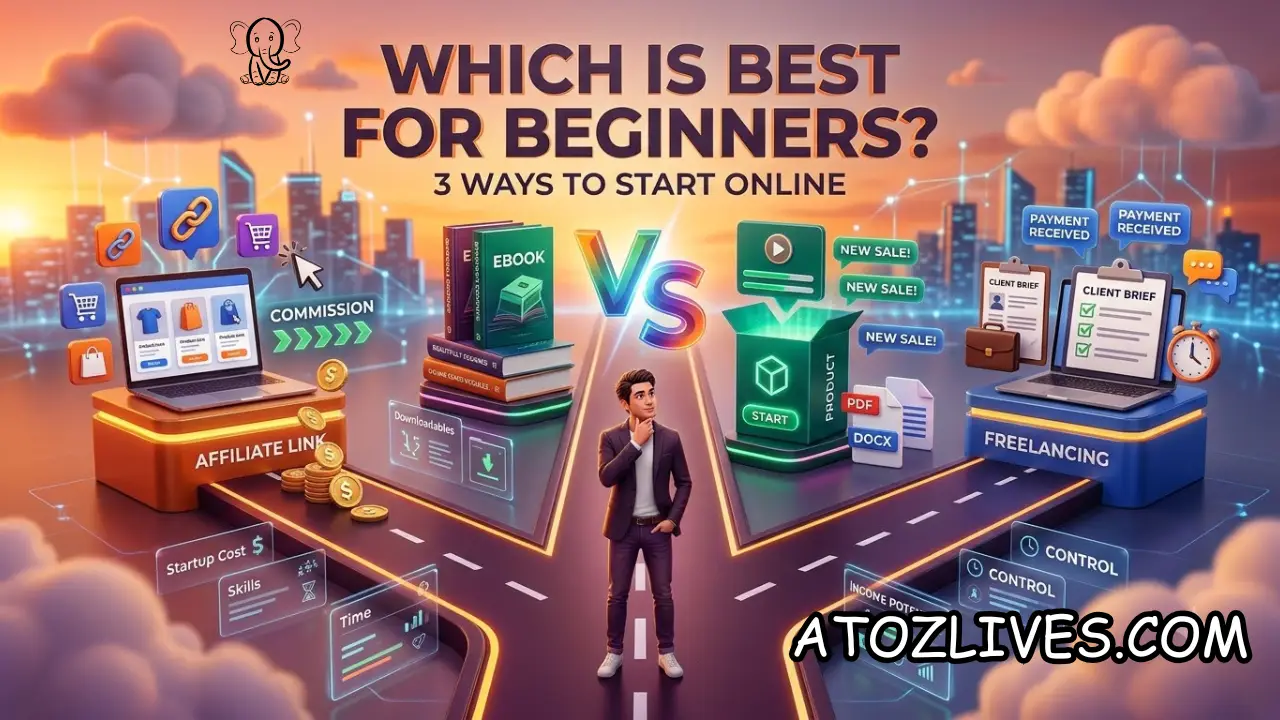
Starting an online business sounds simple until you have to choose what to actually do. In 2026, beginners have more options than ever, but having too many options can make the decision harder. Three models continue to stand out: affiliate marketing, selling digital products, and freelancing.
All three can be started without a traditional office, employees, or a large amount of capital. But they are not the same business. Each requires a different combination of skills, time, marketing, customer interaction, and patience.
Affiliate marketing means recommending products or services and earning a commission when eligible purchases or actions occur through your referral. Digital products involve creating something once, such as a template, ebook, guide, course, or downloadable resource, and selling it online. Freelancing means providing a service directly to clients in exchange for payment.
The right choice depends on what you want from your online business. Someone who enjoys writing product reviews may prefer affiliate marketing. Someone with knowledge that can be packaged into a useful resource may prefer digital products. Someone who already has a marketable skill may reach revenue faster through freelancing.
There is no universal winner. However, for a complete beginner, the three models can be compared based on startup cost, speed to first income, scalability, required skills, customer acquisition, and long-term potential. Understanding those differences can help you avoid choosing a business model simply because someone online claims it is “easy money.”
Are You Ready To Get Paid To Review Apps On Your Phone Then Try It…
Affiliate Marketing Is Easy to Understand but Usually Takes Time to Build
Affiliate marketing is one of the simplest online business models to understand. You find a product or service, join an affiliate program, create content that attracts potential buyers, and include a properly disclosed affiliate link. When someone makes a qualifying purchase through your link, you may receive a commission.
The advantage is that you do not have to create the product yourself. You also do not normally have to manage inventory, shipping, product manufacturing, or customer fulfillment. For beginners, that makes affiliate marketing attractive because the business focuses primarily on traffic, content, trust, and conversions.
However, the simplicity of the model should not be confused with easy income. You need people to see your content, click your links, and actually purchase something. A website with affiliate links but no meaningful traffic is unlikely to generate much revenue.
Affiliate commissions also vary considerably. Amazon’s current U.S. Associates program, for example, calculates commissions according to its applicable commission schedule and qualifying purchases. Amazon also requires clear and conspicuous affiliate disclosures, including the required Associate statement on sites using the program.
This means affiliate marketing works best for people willing to build an audience or a consistent source of targeted traffic. You can use a website, YouTube channel, newsletter, social media account, or other content platform, but the core requirement remains the same: your audience must have a reason to trust your recommendations.
You can try it to save homes from the energy crisis and reduce electricity bills.
Digital Products Give Beginners More Control Over What They Sell
Digital products are different because you own the product creation process. Instead of recommending another company’s product, you create something that customers can purchase directly from you.
A digital product can be relatively simple. It could be an ebook, checklist, spreadsheet, Canva template, Notion template, prompt collection, printable, study guide, business template, design asset, mini-course, or specialized PDF. Current 2026 creator-business coverage in India shows continued interest in small downloadable products such as templates, PDFs, notes, checklists, and creator resources.
The biggest benefit is control over pricing and the customer experience. If you sell a $20 digital product, you keep the revenue after applicable platform fees, taxes, refunds, payment costs, and other expenses. You are not restricted to an affiliate program’s commission percentage.
Digital products can also be more scalable than freelancing. A freelancer generally has to perform work for every client. A digital product can potentially be sold repeatedly without recreating the entire product each time. That does not make sales automatic, because you still need traffic and marketing.
The biggest challenge is deciding what people actually want to buy. Beginners often create large ebooks or courses before validating demand. A smaller product that solves one specific problem can be easier to create, explain, test, and improve.
For example, instead of creating a massive “Ultimate Business Guide,” you could create a spreadsheet that helps freelancers track invoices and monthly income. Instead of a generic social media ebook, you could create a 30-day content calendar for real estate agents. Specific problems usually produce clearer product offers.
How to Start a Blog in 2025: A Step-by-Step Guide for Beginners
Freelancing Can Be the Fastest Path to a Beginner’s First Online Income
Freelancing has a major advantage over the other two models: you can sell a skill directly. You do not necessarily need a large audience, a product catalog, or months of search traffic before you can approach potential customers.
A beginner could freelance in writing, graphic design, video editing, social media management, virtual assistance, web design, translation, bookkeeping, research, presentation design, or many other areas. The important factor is whether the skill solves a problem that someone is willing to pay to have solved.
The revenue calculation is also straightforward. If you charge $50 for a service, ten completed projects produce $500 in gross revenue. If you charge $250, two projects reach the same amount. That does not mean getting those clients will be easy, but it demonstrates why services can produce revenue with a relatively small customer base.
Freelancing does require direct customer interaction. You need to communicate with clients, understand requirements, meet deadlines, make revisions, and sometimes deal with difficult feedback. That makes it less passive than digital products or affiliate marketing.
Competition is another issue. Platforms can contain thousands of freelancers offering similar services. A beginner can improve their chances by specializing instead of presenting themselves as a generalist. “I write blog content for SaaS companies” is easier to position than “I can write anything.”
Current 2026 freelancing discussions in India also emphasize that beginners need a marketable skill, a way to reach clients, and patience while building a reputation. The same principle applies to beginners targeting U.S. or international clients.
You can use it to be healthy and fit forever.
Affiliate Marketing vs Digital Products vs Freelancing: Which Requires the Least Money?
All three models can be started relatively cheaply, but their costs are distributed differently. Freelancing can potentially require the least initial investment because your primary asset is your skill. If you already have a computer and internet connection, you may not need much more than a portfolio and a way to communicate with clients.
Affiliate marketing can also be inexpensive. You can begin by publishing useful content on platforms that have free access. However, building a professional website may eventually involve domain, hosting, email, design, analytics, and content expenses.
Digital products can also be created with inexpensive tools. A basic PDF, spreadsheet, template, or checklist does not require a manufacturing facility. Depending on the product, free or low-cost software can be sufficient for your first version.
The real cost is therefore not simply software. It is time. Affiliate marketing may require months of content creation before traffic becomes meaningful. Digital products require research, product creation, promotion, and customer support. Freelancing requires learning a skill and continuously finding clients.
A beginner should not spend hundreds or thousands of dollars simply because someone claims that an expensive course, software package, or advertising campaign is necessary. Start with the minimum tools required to test the business model.
The better question is not “Which model costs the least?” but “Which model can I test most cheaply while still producing useful results?” For someone who already has a valuable skill, freelancing often wins that comparison. For someone with an audience, digital products or affiliate marketing may make more sense.
Are You Excited To Read about AI Then Click Here…
Which Business Model Can Make Money Faster for a Beginner?
If speed to the first possible payment is the main priority, freelancing generally has the most direct path. You can create a portfolio and start contacting potential customers without waiting for search engines or social algorithms to build an audience.
Imagine a beginner who knows how to edit short videos. They can create three sample videos, identify businesses or creators that need short-form content, and contact potential clients. A client can theoretically hire them after seeing the samples.
Affiliate marketing works differently. Even if you publish excellent content, you still need visitors. Those visitors then need to click an affiliate link and make a qualifying purchase. Building that chain can take considerable time.
Digital products sit somewhere between the two. If you already have an audience, you can potentially sell a product quickly. Without an audience, however, you need a distribution strategy. You may use SEO, social media, email marketing, communities, partnerships, or paid advertising.
This is why the “best online business” depends heavily on what you already have. A person with 20,000 engaged newsletter subscribers has a completely different starting position from someone with no audience but excellent graphic-design skills.
For a complete beginner starting from zero, freelancing is often the most practical first step for learning how online businesses actually work. Once you understand customers, marketing, pricing, and delivery, you can use those skills to build digital products or an affiliate content business later.
You can use it for mental peace and balance.
Which Model Has the Best Long-Term Potential?
Long-term potential is where the comparison becomes more complicated. Freelancing can produce strong income, but your capacity is connected to your available time unless you increase prices, productize services, build a team, or create additional revenue streams.
Digital products have stronger built-in scalability. Once a product is created, the same product can potentially be sold repeatedly. You can also build a catalog where several products serve different customer needs.
Affiliate marketing can also scale because one piece of content can potentially generate commissions from many customers. A useful product comparison or tutorial may continue sending visitors and generating sales long after publication.
However, none of these models is completely passive. Digital products still require updates, marketing, customer support, and product development. Affiliate websites need new content and maintenance. Freelancers need clients and must continue delivering work.
A strong long-term strategy can actually combine the three. For example, a freelance writer could begin by writing content for clients, then create a digital writing template, and eventually publish product comparisons containing relevant affiliate links.
This combination can reduce dependence on a single revenue source. Freelancing can provide immediate cash flow, digital products can provide scalable revenue, and affiliate marketing can monetize useful content without requiring the creator to own every product being discussed.
Want To Get Online Cash…
Affiliate Marketing vs Digital Products vs Freelancing: Which Is Best for Beginners?
For most complete beginners, freelancing is the easiest model to test first because you can sell an existing skill directly and potentially reach a paying customer without building a large audience.
If you already have specialized knowledge, digital products may be the better choice. A useful template, guide, calculator, checklist, or educational resource can turn knowledge into something that can be sold repeatedly.
If you enjoy content creation and are willing to wait for traffic to develop, affiliate marketing can be an excellent long-term model. It works particularly well for people who enjoy researching products, comparing options, explaining complicated topics, and building trust with an audience.
The wrong approach is choosing affiliate marketing because someone promises “passive income,” choosing digital products because someone says they sell automatically, or choosing freelancing because someone claims clients are easy to find. Every model has a difficult part.
A beginner should instead choose based on their strongest existing advantage. Have a skill? Start freelancing. Have expertise people regularly ask you about? Test a digital product. Have an audience or enjoy creating content consistently? Consider affiliate marketing.
The smartest answer may eventually be all three, but not all at once. Start with one model, learn how customers respond, generate your first revenue, and then add a second model when you have a clear reason to do so. That approach is far more realistic than trying to build three businesses simultaneously.
Are You Using Facebook, Twitter and YouTube (Get Paid To Use)
FAQs
1. Which is best for beginners: affiliate marketing, digital products, or freelancing?
For most beginners starting without an audience, freelancing is the easiest model to test because you can sell a skill directly. Digital products and affiliate marketing become more attractive when you have expertise, content, or an existing audience.
2. Is affiliate marketing easier than freelancing?
Affiliate marketing may be easier to understand because you do not need to create or deliver the product. However, generating consistent traffic and conversions can take time. Freelancing requires client acquisition but can produce a direct payment after completing a service.
3. Can I start a digital product business with no audience?
Yes. An audience helps, but it is not mandatory. You can use search traffic, social media, communities, partnerships, marketplaces, or direct outreach to find potential buyers. The product should solve a clearly defined problem.
4. Which online business requires the least investment?
Freelancing can require very little money if you already have the necessary equipment and skill. Affiliate marketing and digital products can also be started cheaply, but all three require time and consistent marketing.
5. Can I do affiliate marketing and sell digital products together?
Yes. They can complement each other well. For example, a website could publish educational content, recommend relevant third-party products through affiliate links, and also sell original templates or guides.
6. How much money can a beginner make from freelancing?
There is no fixed amount. Income depends on your skill, pricing, demand, number of clients, hours available, and ability to retain customers. It is better to focus initially on acquiring a few satisfied clients rather than expecting a specific monthly income.
7. What digital products sell well for beginners?
Useful niche-specific products can be easier to sell than generic products. Examples include templates, spreadsheets, checklists, study resources, planners, business documents, design assets, and specialized guides.
8. Do I need a website for affiliate marketing?
Not necessarily. Depending on the affiliate program and platform rules, creators can use social media, video platforms, newsletters, or other channels. However, owning a website can provide more control over your content and audience acquisition.
9. Do affiliate marketers need to disclose affiliate links?
Yes, appropriate disclosure is important. For example, Amazon Associates requires clear and conspicuous disclosure and specifies required Associate language for participating sites. The exact disclosure requirements can vary by program, platform, and jurisdiction.
10. Can I eventually combine all three business models?
Yes. A practical progression is to start with freelancing for cash flow, turn repeated knowledge into digital products, and use content and affiliate marketing to create additional revenue. Combining models can work well once the first business is stable.
“Live Chat Jobs – You have to try this one”
Ready to Begin?
➜ Click Here to explore top-rated affiliate programs on ClickBank!
➜ Reach Our Free Offers: “Come Here To Earn Money By Your Mobile Easily in 2025.”
Want To Read More Then Click Here…
If You Are Interested In Health And Fitness Articles Then Click Here.
If You Are Interested In Indian Share Market Articles Then Click Here.
Thanks To Visit Our Website-We Will Wait For You Come Again Soon…