

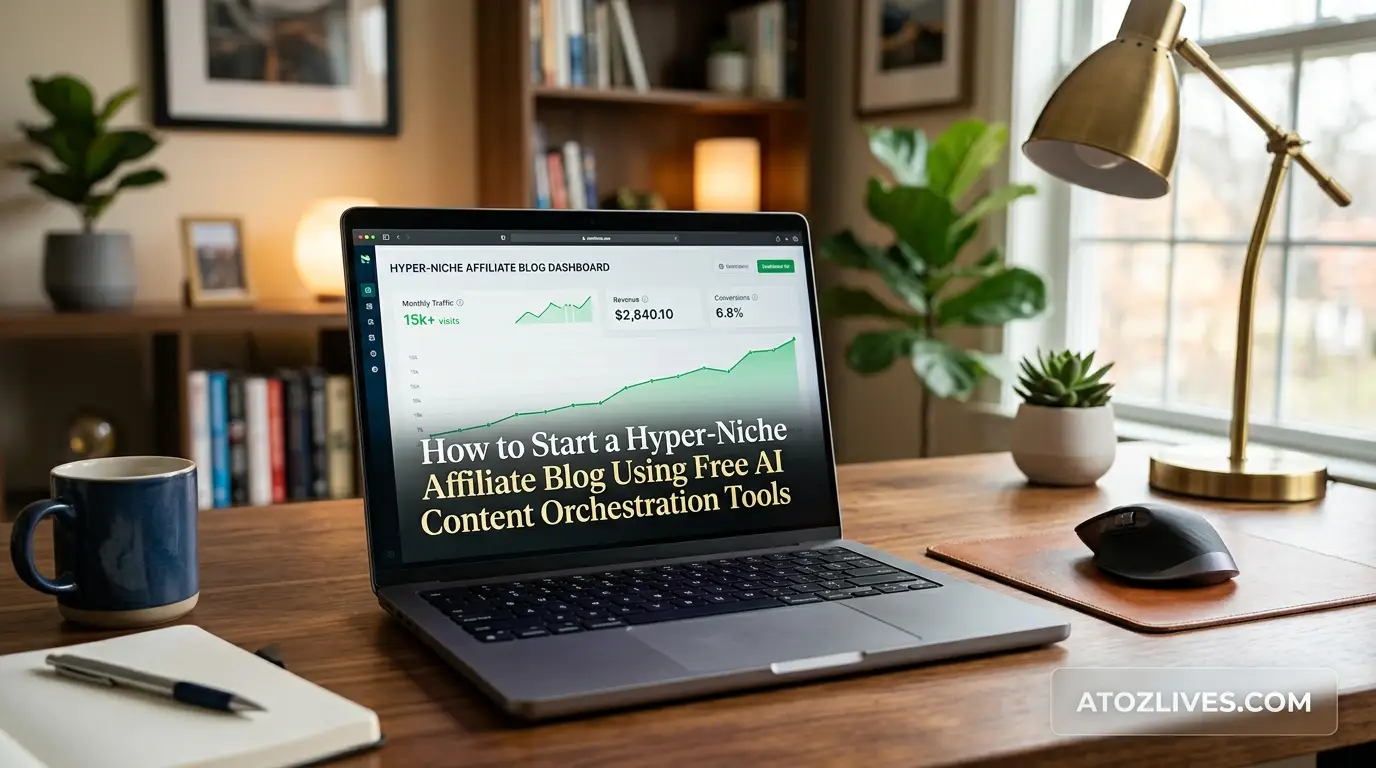
Two months ago, I sat at my desk staring at a completely blank WordPress dashboard. I had zero budget for premium content writers, no money for expensive SEO tools and exactly forty-eight hours to launch a project before my regular client work swamped me again.
I chose an incredibly narrow topic: commercial countertop ice makers for small coffee shops. Most people told me the market was too small to care about, but that was exactly the point.
Instead of typing every single word manually or spending thousands of dollars on freelance writers, I chained together three free AI tools to build a content pipeline.
I did not just generate generic articles; I orchestrated a deeply researched web of highly specific reviews, comparison guides and troubleshooting pieces.
Within forty-five days, the site crossed its first three hundred dollars in affiliate commissions from Amazon and specialized restaurant supply networks.
The traffic was small but highly intentional. Every reader who landed on the site was looking to buy a specific machine immediately.
This guide lays out the exact, actionable blueprint I used to build that system from scratch without spending a single dime on content production.
Are You Ready To Get Paid To Review Apps On Your Phone Then Try It…
The Power of Going Small: Understanding Hyper-Niche Markets
Most beginners fail in affiliate marketing because they target massive, highly competitive categories. They launch blogs about “fitness tracking” or “best tech gadgets” and find themselves competing against multi-million dollar media companies with massive backlink profiles.
A hyper-niche blog turns that dynamic upside down by targeting an incredibly narrow sliver of a market where the competition is practically nonexistent.
Defining the Hyper-Niche Concept
A standard niche might be “camping gear.” A sub-niche would be “backpacking tents.” A hyper-niche is “ultralight canvas tents for cold weather hunting.”
When you drill down this deeply, your total audience size shrinks but the purchasing intent skyrockets.
Visitors searching for these specific terms are not casually browsing; they have a highly defined problem and are looking for a definitive recommendation to make a purchase.
Why Low Competition Equals Fast Ranking
Search engines look for topical authority. If your entire website features twenty detailed articles solely dedicated to a single, specialized type of product, search algorithms quickly view your platform as an expert resource for that specific subject.
You can easily outrank massive generic review sites because their coverage of your specific topic is superficial. They might have one generic overview page, whereas you have a comprehensive ecosystem of detailed information.
How to Start a Blog in 2026: A Step-by-Step Guide for Beginners
What is Free AI Content Orchestration?
Many people mistake AI content creation for simply typing a vague prompt into a chatbot and pasting the messy, generic output directly into a content management system.
That approach leads to low-quality websites that rank poorly and fail to convert readers into buyers. True content orchestration treats artificial intelligence as a collection of specialized assembly line workers, all managed by a strict human director.
Moving Beyond Simple Prompting
Content orchestration is the process of breaking down the entire editorial workflow into small, modular tasks. You use one specialized prompt to extract raw data, another to organize a comprehensive outline, a third to draft specific sections with real-world examples and a fourth to audit the text for tone and clarity.
By controlling every single step of the layout, you prevent the machine from generating repetitive patterns, fluff, or fake information.
The Stack of Free Tools
You do not need paid subscriptions to execute this strategy effectively. The entire ecosystem can be built using the free tiers of widely available platforms.
-
Claude (Free Tier): Excellent for deep semantic analysis, creating logical content structures and writing in a natural, analytical tone.
-
ChatGPT (Free Tier): Ideal for rapid brainstorming, generating raw keyword variations and processing structured data.
-
Google Docs and Sheets: The central nervous system where you store prompts, track your content calendar and organize your keywords.
Are You Excited To Read about AI Then Click Here…
Step 1: Finding Your Micro-Monetizable Sub-Market
Before you write a single word, you must validate that your chosen topic can actually generate money. A hyper-niche needs a perfect balance of low search competition and clear commercial value.
Evaluating Affiliate Programs
Look for products that cost between one hundred and one thousand dollars. If the product is too cheap, you will need massive traffic to make a meaningful profit.
If it is too expensive, the buying cycle takes months and requires complex sales funnels. Look for specialized e-commerce stores, industrial suppliers or mainstream platforms like the Amazon Associates program.
Ensure the target products have steady inventory and active customer reviews across the web.
The Zero-Dollar Keyword Research Blueprint
You do not need premium SEO software to find incredible keywords. Start by using Google search itself. Type a broad product category into the search bar and look closely at the “People Also Ask” section.
These are real, unedited questions that users are typing into the search engine right now.
Another powerful method is to look at online forums and community boards. Look for recurring threads where users complain about specific product flaws or ask for direct comparisons between two obscure models.
These complaints and comparisons are your future article titles.
Want To Get Online Cash…
Step 2: Designing Your Content Architecture
A successful affiliate blog is not just a random collection of articles; it is a carefully structured map of information. This organization helps search engines crawl your site efficiently and keeps readers clicking from one article to the next.
The Hub and Spoke Model
Your site structure should rely on a framework known as the hub-and-spoke model.
-
The Hub Page: A comprehensive, high-level guide that covers a broad topic. For example, “The Ultimate Guide to Outfitting a Small Coffee Shop Kitchen.”
-
The Spoke Pages: Highly specific articles that dive deep into individual subtopics mentioned on the hub page. For example, “Review of the XYZ Commercial Under-Counter Ice Machine.”
Every single spoke page must link back to the main hub page and the hub page must link out to every spoke page.
This internal linking strategy passes authority across your entire domain and signals to search engines that your content is thoroughly organized.
Core Hub Page (Ultimate Guide)
Spoke 1 Spoke 2
(Product Review) (Comparison Guide)
Mapping the Buyer’s Journey
Your content mix must address users at different stages of the decision-making process. You need informational content to build trust and commercial content to drive revenue.
-
Informational Phase: Articles solving specific problems, such as “Why is my commercial ice machine making cloudy ice?”
-
Comparison Phase: Side-by-side breakdowns, such as “Brand A vs Brand B Ice Makers.”
-
Transactional Phase: Direct buyer guides, such as “Best water-efficient ice makers for small businesses.”
Are You Using Facebook, Twitter and YouTube (Get Paid To Use)
Step 3: Setting Up Your Free Orchestration Workspace
Efficiency is the secret to scaling a hyper-niche blog. You must organize your workspace so that you can move from a keyword concept to a finished article layout in less than thirty minutes.
Creating the Master Prompt Database
Never type prompts from scratch every time you sit down to work. Create a dedicated document where you store your proven, tested prompt templates.
Label them clearly based on their role in your editorial assembly line: Outline Generator, Data Extractor, Introduction Writer and Product Review Reviewer.
Setting Up Your Content Tracking Sheets
Open a free spreadsheet and build a simple tracking system. Your columns should track the target keyword, the current stage of production, the internal links you need to include and the publication date.
This simple visual guide ensures you never lose momentum and prevents you from accidentally writing duplicate content for the same search term.
The Smoothie Diet : 21 Day Rapid Weight Loss Program
Step 4: The Step by Step AI Content Assembly Line
This is where the actual orchestration happens. We will walk through the exact process of building a highly detailed, human-sounding product round-up guide using modular prompts across free tools.
Phase A: Deep Research and Data Extraction
AI models often hallucinate specific product specs if you ask them to write broadly. To prevent this, you must feed the system real, verified data.
Go to the manufacturer website or a major retail listing for the product you want to review. Copy the raw technical specification table and paste it directly into your chat tool alongside this prompt:
“Extract the core technical dimensions, power requirements, daily output limits, and prominent user complaints from this raw data. Present these facts in clean, unformatted bullet points. Do not add any conversational filler or introductory text.”
Phase B: Generating a Highly Structured Outline
Now that your tool understands the raw facts, use Claude or ChatGPT to design an extensive outline. Feed it your target keyword along with the extracted data and use this prompt:
“Create an extensive article outline for the target keyword [Insert Keyword]. The outline must include an introductory section, a detailed breakdown of three specific technical features, a dedicated pros and cons list based strictly on the provided user complaints, and a final purchasing recommendation. Use standard H2 and H3 formatting for the sections.”
Phase C: Drafting Modular Sections
Never ask the system to “write the whole article now.” It will run out of memory, lose track of the tone and skip important technical details. Instead, command it to write one single section at a time. Start with the introduction using this prompt:
“Write the introductory section for the outline above. Start directly with a relatable real-world scenario or common frustration an owner faces. Use an analytical, helpful American English tone. Avoid overly dramatic adjectives, do not use cliché transition words, and ensure you do not use a comma before ‘and’ or ‘or’ in your sentences.”
Once the introduction is complete, review it thoroughly. If it looks good, paste it into your master document and move to the next section of the outline using a similar highly specific command.
Repeat this process until every section of your outline is completely filled out with deep, factual text.
Paid Online Writing Jobs – Get Paid To Do Simple Writing Jobs Online
Step 5: Injecting Absolute Authenticity and Eliminating Fluff
When you finish drafting your sections, you will have a highly detailed article but it may still feel slightly mechanical.
To convert casual visitors into paying customers, you must polish the text until it reads like a piece written by an experienced industry professional.
Removing Telling Patterns and Predictable Phrasing
Machines absolutely love certain words and phrases. Scan your text thoroughly and manually delete words like “testament” “revolutionize” “delve” “furthermore” “in conclusion” and “it is important to remember.”
Replace these words with simple, direct transitions that real people use when speaking to a colleague.
Adding Realistic Texture and Micro-Nuance
To make an affiliate review truly authentic, you must include micro-nuances that only a real user would notice. Mention how a specific power cord is slightly too short to reach a standard wall outlet comfortably.
Discuss how the stainless steel exterior easily collects fingerprints and requires frequent wiping. These tiny, practical observations build immense trust with your readers and make your content stand out from generic, superficial reviews.
Step 6: On-Page SEO Optimization Without Paid Plugins
You do not need expensive software extensions to optimize your blog post for search engine rankings. You can handle the entire process manually by following fundamental on-page principles.
Strategic Keyphrase Placement
Your focus keyphrase must appear in a few critical locations so that search crawlers immediately understand the primary purpose of the page.
Place it clearly within the first hundred words of your introduction, inside at least one H2 heading, naturally within the body text every few hundred words and directly inside your final summary paragraph.
Avoid overusing the term; it should fit into the sentences naturally without feeling forced.
Optimizing Headers and Meta Text
Ensure your H2 and H3 headings use clear variations of your target topic. Your meta description should be exactly twenty words long, include your primary keyphrase and provide a compelling reason for a user to click on your link in the search results.
Keep your URL structures short and descriptive by using only your primary keyphrase separated by simple dashes.
You also can use MITOLYN to get an overall healthy body in a natural way.
Step 7: Monetization Mechanics That Drive Conversions
Writing a great article is only half the battle; you must design the page layout to encourage users to click your affiliate links without feeling pressured.
Elegant Product Tables
Place a clean, scannable comparison table near the very top of your product round-up articles. Many visitors are in a hurry and want to see your top recommendation immediately without reading a massive text guide.
Your table should clearly display the product name, its primary benefit and a prominent call-to-action button.
| Product Name | Best For | Action |
| Premium Ice Maker | High-Volume Cafes | [Check Price] |
| Compact Model | Limited Counter Spc | [Check Price] |
Contextual Text Hyperlinks
Do not rely solely on big, flashing buttons to drive clicks. Scatter natural text links throughout your detailed paragraphs. Link the specific model names directly to the retailer when you mention them in your analytical teardowns.
Readers often click these contextual links because they occur naturally while they are deeply engaged in learning about a product feature.
You can use it to control blood pressure and increase the strength of the heart.
Step 8: Scaling the System and Maintaining Authority
Once your first five articles are live, you must maintain a steady momentum to build true topical authority in your chosen niche.
Developing an Orderly Production Schedule
Commit to publishing two highly detailed pieces of content every single week. Use your tracking spreadsheet to plan your writing blocks in advance.
Spend one evening extracting raw data for three different products, another evening generating your outlines and a weekend morning assembling and polishing the text sections.
Regular Content Maintenance
Affiliate blogging is not a completely hands-off project. Products get discontinued, specifications change and new models enter the marketplace.
Set aside one day every few months to review your older, top-performing articles. Update any outdated pricing details, swap out broken product links and add new user feedback to ensure your guides remain the most accurate resources on the web.
FAQs
1. Can a brand new blog honestly rank on search engines without buying backlinks?
Yes, you can absolutely rank without purchasing backlinks if you target incredibly narrow hyper-niche keywords. Search engines prioritize depth of information and topical accuracy over sheer domain authority when answering highly specific queries.
By creating an interconnected web of detailed guides on a single obscure subject, your platform becomes the most relevant source available for those terms.
2. How long does it usually take to see the very first affiliate sale from a new site?
You can generally expect to see your first affiliate commission within thirty to sixty days after publishing your initial cluster of articles.
This timeline depends heavily on how fast search engine crawlers index your new pages and where your target keywords rank. If you target long-tail terms with minimal competition, you can attract targeted buyers almost immediately.
3. Will search engines penalize my affiliate blog for using AI tools to help write content?
Search networks do not penalize content simply because AI tools helped create it. Their systems focus heavily on the overall quality, accuracy, and helpfulness of the final text.
If your articles are full of repetitive fluff, fake specifications, or bad formatting, your rankings will suffer. If you orchestrate the tools to build deeply researched, well-structured, and genuinely useful guides, your site will rank well.
4. What is the safest way to find high-value products to promote without an expensive tool?
The easiest strategy is to explore major online retail platforms and corporate product directories directly. Look for specialized industrial suppliers, trade equipment stores, or look closely at the best-seller categories on Amazon.
Focus your search on items priced above one hundred dollars that have active customer review sections, as this confirms people are buying them regularly.
5. How many articles do I need to publish before my hyper-niche blog looks established?
You should aim to launch your site with a core cluster of fifteen to twenty deeply detailed articles. This initial batch should include one comprehensive main hub guide, several individual product reviews and a handful of practical troubleshooting pieces.
Having this amount of structured content shows search engines that you have thoroughly mapped the specific sub-market.
6. Is it better to join the Amazon affiliate program or sign up for private affiliate networks?
It is best to use a combination of both options to maximize your revenue. The Amazon program is fantastic for beginners because it is easy to join and consumers trust the checkout process completely.
Private affiliate programs or specialized industrial suppliers often offer much higher commission percentages and longer tracking cookie durations, making them incredibly profitable for high-ticket niche items.
7. How do I keep my content accurate when I do not personally own the products I review?
You can maintain high accuracy by gathering and synthesizing raw technical data from official manufacturer manuals, spec sheets, and verified customer feedback threads.
Combine this data with real-world user complaints found on public forums. This detailed approach allows you to highlight specific practical flaws and clear benefits that general overview sites completely miss.
8. What should I do if a product I am actively promoting gets discontinued by the manufacturer?
When a product is discontinued, you should leave the original review page live but add a prominent update note right at the top of the article.
Explain that the model is no longer available and provide a direct text link to its official updated replacement or your current top alternative recommendation. This strategy keeps your search traffic safe while redirecting buyers smoothly.
9. How much time do I need to spend every week to run this affiliate system successfully?
You can easily run this entire system by dedicating roughly eight to ten hours every week.
Because the free AI content orchestration process breaks writing down into fast, modular steps, you can research, build, and polish a comprehensive article in under an hour, allowing you to easily manage the site alongside a regular job.
10. Can I expand my hyper-niche blog into a broader category later on if I want to?
Yes, you can easily scale up your platform once you completely dominate your initial narrow category.
If your blog about commercial coffee shop ice makers is highly profitable, you can easily expand it by adding a new section for commercial espresso machines or under-counter refrigeration units.
This growth strategy allows you to scale your traffic smoothly while keeping your hard-earned domain authority intact.
“Live Chat Jobs – You have to try this one”
Ready to Begin?
➜ Click Here to explore top-rated affiliate programs on ClickBank!
➜ Reach Our Free Offers: “Come Here To Earn Money By Your Mobile Easily in 2025.”
Want To Read More Then Click Here…
If You Are Interested In Health And Fitness Articles Then Click Here.
If You Are Interested In Indian Share Market Articles Then Click Here.
Thanks To Visit Our Website-We Will Wait For You Come Again Soon…