

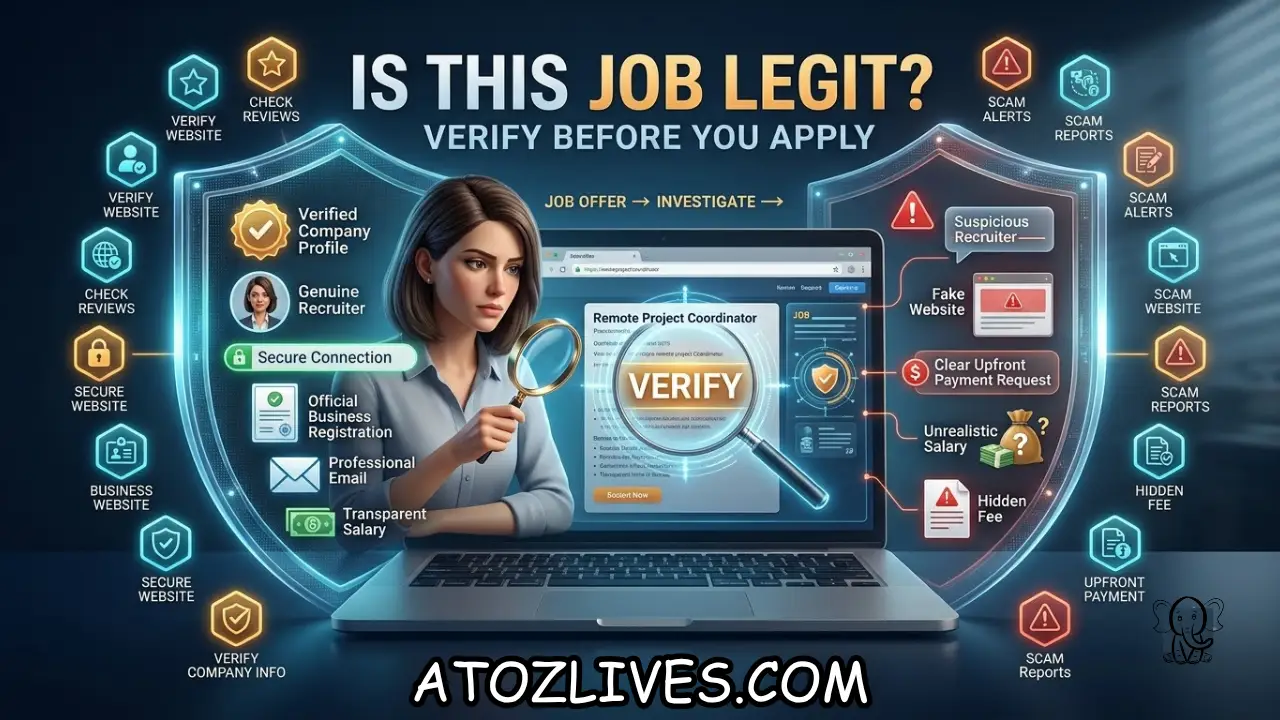
Searching for a remote job can feel like a full-time job itself. Thousands of work-from-home opportunities appear across job boards, social media, company websites, email, and messaging platforms. Unfortunately, not every listing is connected to a real employer.
Fake remote jobs have become more convincing. A scammer may use the name of a real company, copy a legitimate job description, create an official-looking offer letter, or pretend to be a recruiter. In 2026, the FTC has specifically warned about fake recruiters contacting people by text with supposed remote positions and trying to move them toward money or personal-information scams.
That means you should not decide whether a job is legitimate simply because the listing looks professional. You need to verify the employer, recruiter, job description, application process, compensation, and communication methods.
The good news is that you do not need to be a cybersecurity expert to perform a basic job verification. A few simple checks can reveal major inconsistencies before you submit sensitive information or spend money.
The following 12 checks are designed for Americans looking for legitimate work-from-home opportunities. They can help you slow down, investigate the offer independently, and recognize common warning signs before applying.
Are You Ready To Get Paid To Review Apps On Your Phone Then Try It…
Verify the Company on Its Official Website Before You Apply
The first step in checking whether an online job is legitimate is finding the company yourself. Do not rely solely on the website, phone number, or career-page link supplied by the person who contacted you.
Open a new browser window and search for the company’s official website. Look for its careers or jobs section and compare the position you received with the listings published there. The FTC recommends verifying job openings through the organization’s official website rather than assuming that a job advertisement using a company’s name is genuine.
Pay attention to the exact domain name. A scammer can create a website that looks similar to a real business while using a slightly different web address. An extra word, unusual spelling, or different domain can be enough to distinguish an impersonation site from the legitimate company.
Also check whether the company has a genuine business presence outside the website. Look for established social profiles, credible business information, employee profiles, news coverage, and other independent references. A website created recently with almost no independent footprint deserves additional scrutiny.
If you cannot independently confirm that the company exists and actually hires for the advertised role, do not proceed simply because the recruiter keeps insisting that the offer is genuine. The purpose of verification is to confirm the opportunity without relying on the person who benefits from convincing you.
Check Whether the Recruiter and Email Address Are Genuine
The person contacting you deserves just as much scrutiny as the company. Scammers frequently impersonate recruiters from recognizable companies because a familiar name immediately creates trust.
Start by examining the sender’s email address. A recruiter claiming to represent a major corporation would generally be expected to communicate through an appropriate company domain rather than a random Gmail or Yahoo account. The FTC specifically lists personal email addresses as a warning sign when someone claims to represent a legitimate employer.
A personal email address is not automatic proof of fraud. Small businesses and independent recruiters may use different communication systems. The important question is whether the recruiter can be independently verified.
Search the recruiter’s name together with the company name and terms such as “scam,” “complaint,” or “review.” The FTC recommends this type of research when evaluating unexpected job opportunities.
Do not use only the contact information provided by the recruiter to verify the recruiter. Instead, find the employer’s official website yourself and use its publicly available contact information. If necessary, contact the company and ask whether the person and position are genuine.
How to Start a Blog in 2025: A Step-by-Step Guide for Beginners
Check the Job Description, Salary, and Hiring Process for Red Flags
A legitimate job description should explain what you will actually do. It should normally include responsibilities, qualifications, expected working arrangements, and enough information for a candidate to determine whether the position is appropriate.
Be cautious when the description is extremely vague. Phrases such as “online work,” “simple tasks,” “optimization,” “product boosting,” or “earn money from your phone” can be warning signs when they are not accompanied by clear information about the actual employer and responsibilities.
The FBI has warned about work-from-home scams involving simple online tasks, including fake “optimization” work. In these schemes, victims may see supposed earnings on a fake platform and later be asked to deposit their own money, often cryptocurrency, to continue working or withdraw the supposed earnings.
Compensation also deserves attention. A high salary is not automatically suspicious, but an offer promising unusually large amounts of money for minimal effort should make you slow down. The FTC warns that scammers often promise large earnings for little work.
The hiring process should make sense for the position. If you are supposedly hired after answering a few generic messages and the employer immediately requests bank details, identification, or money, stop. A fast hiring process is not necessarily fraudulent, but skipping meaningful verification while demanding sensitive information is a serious warning sign.
Never Pay Money to Get a Work-From-Home Job
One of the strongest ways to identify a fake remote job is to look at whether the supposed employer asks you to pay money before you can work.
Legitimate employers pay employees or contractors for their work. They do not normally require applicants to purchase a starter package, pay a registration fee, buy access to a job portal, or pay a recruiter simply to receive employment.
The FTC is direct about this: honest employers will not ask you to pay to get a job. It also warns against supposed training, certification, and starter-kit expenses that are presented as requirements for employment.
Be particularly cautious when someone says the payment is temporary or refundable. Scammers can create convincing explanations for why you supposedly need to send money first. The promise of reimbursement does not make an upfront payment safe.
Cryptocurrency requests deserve especially strong caution. The FBI has warned about fake work-from-home jobs where victims are instructed to make cryptocurrency payments to unlock additional work or supposed earnings.
The same principle applies to gift cards, wire transfers, and unusual payment arrangements. If the job turns into a situation where you are sending money to your supposed employer, stop the process. A legitimate employment opportunity should not require you to pay money simply to receive the opportunity.
Are You Excited To Read about AI Then Click Here…
Protect Your Social Security Number, Bank Information, and Identity
A job application can legitimately require personal information at certain stages, but you should not provide sensitive information simply because an unknown recruiter asks for it.
Scammers may use fake job applications to collect Social Security numbers, driver’s license information, bank account details, addresses, and other data. The FTC warns that scammers sometimes request this information before a genuine interview or hiring process has taken place.
Think about timing. If someone contacts you unexpectedly, gives you little information about the position, and immediately asks for your Social Security number or bank account number, you should stop and verify the employer first.
The same caution applies to links and forms. A professional-looking application page does not prove that it belongs to the company. Scammers can create websites and forms designed specifically to collect personal information.
Government job seekers should be especially careful about official-looking messages. USAJOBS warns that phishing messages can contain suspicious links or attachments and says it will not ask for Social Security or financial information through email.
Do not send sensitive information just because someone says it is required for direct deposit or onboarding. First verify the company, the position, the recruiter, and the hiring stage. Legitimate employers can wait until the appropriate part of the process.

Watch for Fake Checks, Equipment Purchases, and Reshipping Jobs
Fake-check scams are among the most important work-from-home schemes to understand. A supposed employer may send you a check and tell you to deposit it, keep part of the money, and use the rest to purchase equipment or send money to another person.
The check may initially appear to clear. That does not mean it is legitimate. The FTC warns that banks can later determine that the check is fraudulent, leaving the victim responsible for money that was already transferred or spent.
Never assume that money appearing in your bank account means you have safely earned it. If a supposed employer sends a check and then tells you to send some of the money back, purchase gift cards, or pay a third party, stop.
Reshipping is another work-from-home warning sign. A fake employer may hire you to receive packages at home, inspect or repackage them, and send them to another address. The FTC has identified reshipping as a work-from-home scam.
You should also question jobs involving expensive equipment purchases from a vendor selected by the recruiter. If the employer sends you money and directs you to purchase equipment through a specific person or website, verify the arrangement independently before doing anything. Legitimate employment should not require you to participate in suspicious money transfers.
Want To Get Online Cash…
Use Independent Research Before You Submit Your Application
Once you have checked the obvious warning signs, perform independent research. Search the company name, recruiter name, phone number, email address, and exact job title separately.
The FTC recommends searching for a company or hiring person together with terms such as “scam,” “review,” or “complaint.” This can reveal reports from other applicants or workers who encountered the same offer.
Do not assume that positive reviews automatically prove legitimacy. The FTC has warned that testimonials and success stories can be fake or misleading. A website filled with glowing comments is not enough evidence by itself.
Look for consistency across independent sources. Does the company describe the same business activity on multiple platforms? Does the recruiter appear to have a genuine professional history? Does the advertised job appear on the official career page? Do the contact details match?
Take your time. Scammers often create urgency by claiming that you must accept the opportunity immediately. The FTC specifically warns that pressure to make a quick decision is a red flag.
If the opportunity survives independent verification, you can continue with greater confidence. If several details do not match, there is no reason to risk your money or personal information just because the job sounds attractive.
FAQs
1. How can I tell if an online job is legitimate?
Verify the company independently, check the recruiter and email address, confirm the job on the official company website, research complaints, examine the hiring process, and never pay money to receive the job.
2. Is a work-from-home job that contacts me by text automatically a scam?
Not every text message is fraudulent, but unsolicited job texts deserve caution. The FTC issued a 2026 warning about fake recruiters using unexpected texts to offer supposed remote positions.
3. Should I give my Social Security number before an interview?
Be very cautious. The FTC warns that scammers may request Social Security numbers and other sensitive information before a legitimate interview or hiring process. Verify the employer first.
4. Can a legitimate employer ask me to buy equipment?
A legitimate employer may have equipment policies, but you should be suspicious if you are required to send money to a recruiter or unknown vendor, particularly after receiving a check from the supposed employer.
5. Is a job that asks for an upfront fee a scam?
An upfront payment to obtain a job is a major warning sign. The FTC says honest employers do not ask people to pay to get a job.
6. What if a remote employer sends me a check?
Do not assume the check is legitimate. If the employer tells you to deposit it and send part of the money elsewhere, it is a classic fake-check warning sign.
7. Are Telegram and WhatsApp job offers legitimate?
They can be used for legitimate communication in some circumstances, but unsolicited job offers through messaging apps deserve significant caution. The FTC specifically warns about unexpected WhatsApp, Telegram, and text messages involving task and job scams.
8. How do I verify a recruiter?
Search the recruiter’s name and company independently, check whether the recruiter has a credible professional presence, and contact the company through information found on its official website rather than relying on contact details supplied by the recruiter.
9. What should I do if I already sent money to a fake job?
Contact the payment provider or financial institution immediately and explain that you may have been defrauded. You can also report the incident to the FTC at ReportFraud.ftc.gov and, where appropriate, the FBI’s Internet Crime Complaint Center.
10. Where can I find legitimate U.S. government remote jobs?
For federal employment, USAJOBS is the official federal government job-search website. Verify government employment opportunities directly through USAJOBS rather than relying on unsolicited messages or unofficial websites.
“Live Chat Jobs – You have to try this one”
Ready to Begin?
➜ Click Here to explore top-rated affiliate programs on ClickBank!
➜ Reach Our Free Offers: “Come Here To Earn Money By Your Mobile Easily in 2025.”
Want To Read More Then Click Here…
If You Are Interested In Health And Fitness Articles Then Click Here.
If You Are Interested In Indian Share Market Articles Then Click Here.
Thanks To Visit Our Website-We Will Wait For You Come Again Soon…