
AI automation is becoming a practical business service rather than something limited to software engineers and large technology companies.
Small businesses across the United States are increasingly experimenting with AI for marketing, customer service, productivity, communication, analytics, and other everyday tasks.
That creates an opportunity for people who understand business problems but do not know how to write complex software.
You do not necessarily need to become a programmer to help a local business automate repetitive work.
Modern no-code and low-code tools can connect applications, move information between systems, generate content, summarize customer inquiries, organize leads, send notifications, and perform other repetitive tasks.
But there is an important distinction between using an AI tool and selling an AI automation service.
A business owner is not paying you simply because you know how to open an AI chatbot. They are paying for a useful business outcome.
The most successful beginner approach is therefore to focus on a specific problem, understand the client’s existing workflow, build a practical solution, test it carefully, and explain the value in business terms.
Are You Ready To Get Paid To Review Apps On Your Phone Then Try It…
Why Small Businesses Are Looking for AI Automation Services in 2026
The opportunity exists because AI adoption among U.S. businesses is growing, but adoption is not evenly distributed.
The U.S. Census Bureau reported that business AI use hovered between 17% and 20% from December 2025 through May 2026, with larger companies generally adopting faster than smaller firms.
Small businesses are not ignoring AI. Research from the Federal Reserve Bank of San Francisco found that nearly 40% of small-business respondents in its 2024 survey were already using or planning to use AI.
Their reported applications included productivity, marketing, communications, customer service, analytics, and visual content.
The problem is that knowing AI exists is different from knowing how to implement it. A business owner may have heard about AI agents, automated workflows, chatbots, and generative AI but still have no idea which process should be automated first.
That gap creates an opportunity for a service provider. Instead of selling an abstract “AI transformation,” you can help a business identify one repetitive process and improve it.
For example, a home-service company might receive inquiries through a website form, email, and social media.
Someone then has to read the inquiry, identify the service requested, enter information into a CRM, notify the appropriate employee, and follow up with the prospect. Parts of that workflow may be suitable for automation.
The business does not really care which AI model or automation platform you use. It cares that fewer leads are missed, employees spend less time on repetitive administration, and customers receive faster responses.
That distinction should shape your entire business. Sell the result, not the technology.
How to Start a Blog in 2025: A Step-by-Step Guide for Beginners
You Do Not Need to Be a Programmer to Start an AI Automation Business
Programming and automation are related, but they are not the same skill. Traditional programming involves writing software logic and code, while many modern automation systems allow users to connect existing applications through visual interfaces.
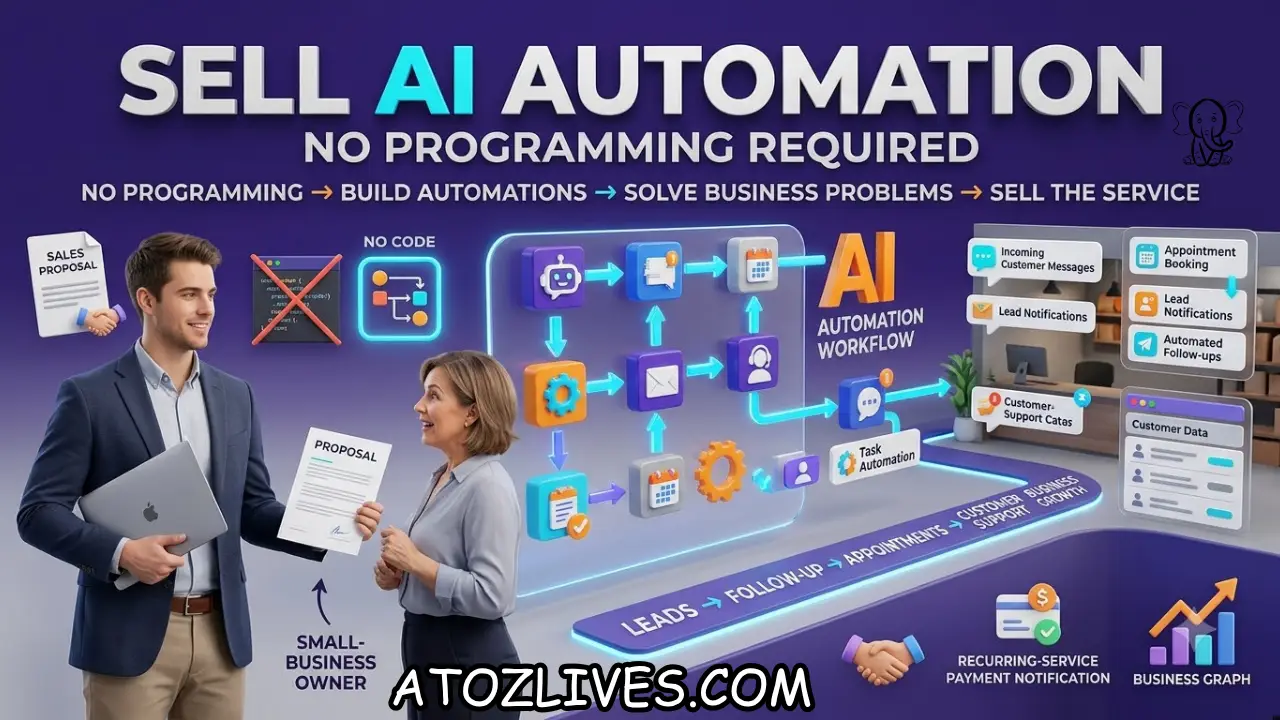
A no-code workflow might receive information from a form, send that information to an AI system for classification, save the result in a spreadsheet or CRM, and notify a team member.
You can build the workflow by configuring steps rather than writing an entire software application from scratch.
That does not mean technical knowledge is unnecessary. You still need to understand triggers, actions, conditions, data fields, permissions, errors, integrations, and testing. You also need to understand what the client’s business actually does.
Think of yourself less as a software developer and more as a workflow designer.
Your job is to look at a process and ask where information enters, what happens next, who handles it, which steps are repetitive, what decisions are predictable, and where a human still needs to review the result.
AI can then be introduced where it genuinely improves the workflow.
For example, an AI system might summarize a long customer message, classify an inquiry, draft a response, extract information from a document, or turn unstructured text into structured fields.
A human can remain responsible for important decisions rather than allowing the system to operate without oversight.
This human-review approach is particularly important because AI output is not automatically accurate.
Current research increasingly emphasizes that organizations need governance, data readiness, and human oversight as AI moves from experimentation into business operations.
Clutch’s 2026 research, for example, found that AI-using small businesses achieving greater maturity were connecting AI to business goals, training, infrastructure, and governance.
You therefore do not need to advertise yourself as a programmer. You can position yourself as someone who helps small businesses identify and implement practical AI-powered workflows.
Are You Excited To Read about AI Then Click Here…

Choose One Profitable Automation Problem Before Looking for Clients
A common beginner mistake is offering “AI automation for everything.” That sounds impressive but gives a potential client no clear reason to hire you.
Instead, choose one type of problem.
Lead follow-up is one example. A business receives a new inquiry, automatically records the lead, categorizes the request, sends an appropriate acknowledgment, alerts the salesperson, and schedules a follow-up reminder.
Customer-support assistance is another. Frequently asked questions can be organized into a knowledge base, while AI can help draft responses to routine inquiries. More sensitive or unusual questions can still be routed to a human employee.
Appointment workflows can also contain repetitive steps. A customer submits a request, receives confirmation, gets a reminder, and the business receives an internal notification. Automation can reduce the amount of manual coordination involved.
Content workflows are another potential service. A business can provide a topic, product information, or announcement, after which a workflow helps generate a draft, organize it, prepare variations, and route it to a person for approval.
Document processing can also be useful. Businesses regularly receive forms, inquiries, invoices, applications, or other documents containing information that employees must manually read and organize.
Depending on the type of information and the tools involved, parts of that process may be automated.
The key is not to ask, “What cool AI automation can I build?” Ask, “What repetitive task costs this business time every week?”
That question leads to better services because it starts with a measurable business problem.
Want To Get Online Cash…
How to Find U.S. Small Businesses That Could Actually Buy Automation
You do not need to target every small business in America. In fact, choosing a specific type of business can make selling much easier.
Start with industries where repetitive communication and administrative work are common.
Examples include home-service companies, property managers, real estate businesses, marketing agencies, professional service firms, clinics, e-commerce companies, consultants, and local service providers.
You should research a potential business before contacting it.
Look at its website. Examine the contact process. Check whether it has an online booking system. Look at how inquiries are handled.
Check whether customers are asked to fill out forms. Look at reviews for complaints involving slow responses or communication.
You are looking for evidence of friction.
Suppose a business has a contact form asking customers several questions but provides no immediate confirmation. That could be an opportunity to propose an automated acknowledgment and internal notification system.
Suppose a business receives many reviews asking the same basic questions. That could indicate an opportunity for better FAQ organization or customer-service assistance.
Suppose a business has a large sales team but manually copies information from emails into a CRM. That may be an automation opportunity.
Your outreach should then mention the specific problem you noticed.
Instead of saying, “I provide AI automation services,” you could say that you noticed the company receives inquiries through its website and that you have an idea for reducing manual lead handling.
That is much easier for a business owner to understand.
You can use it for mental peace and balance.
How to Sell AI Automation Without Talking Like a Technology Company
Your sales message should use the language of the business owner rather than technical terminology.
A small-business owner may not care about APIs, webhooks, LLM orchestration, vector databases, or automation architecture. Those concepts can be relevant during implementation, but they should not dominate the initial sales conversation.
Instead, talk about time, response speed, missed opportunities, repetitive work, consistency, and operational efficiency.
For example, instead of saying, “I can integrate an LLM with your CRM using an automated webhook architecture,” explain that you can create a workflow that reads new inquiries, organizes the important information, updates the appropriate record, and alerts the team.
The second explanation communicates a business outcome.
You also need to avoid promising unrealistic results. Do not tell a business that automation will definitely double revenue or eliminate an employee unless you have strong evidence and the specific situation supports that claim.
The Federal Trade Commission has taken action against AI-related business opportunity companies over deceptive claims about earnings and business growth.
That is a useful reminder that your own marketing should be based on realistic, supportable claims rather than guaranteed income or guaranteed business results.
A professional proposal should explain what you will automate, what the client will provide, what the workflow will do, what remains under human control, how the system will be tested, and what ongoing support is included.
You should also explain limitations.
If an AI-generated customer response requires human approval, say so. If the automation depends on a third-party application, say so. And If the system cannot guarantee perfect classification, do not imply that it can.
Honest positioning can actually make you more credible because business owners understand that technology has limitations.
How to Build Your First AI Automation Demo Without a Client
You do not have to wait for a paying customer before creating a portfolio.
Build a demonstration around a fictional business or a generic workflow. For example, create a demo for a fictional home-services company that receives leads through an online form.
Show the process from beginning to end.
A potential customer submits a form. The workflow captures the information. AI categorizes the inquiry. The information is stored in a structured location.
The business receives an internal notification. The customer receives an appropriate acknowledgment.
You can record a short screen demonstration showing how the workflow works.
Create another demonstration for customer-service assistance. Use a fictional knowledge base and show how an incoming question can be analyzed and turned into a draft response for human review.
A third demo could focus on document processing. Show how information from a sample document can be extracted and organized into structured fields.
The purpose of the demo is not to prove that you can build the most sophisticated AI system in the world.
It is to prove that you understand workflows.
Your portfolio should clearly explain the problem, the old manual process, the automated process, where AI is used, where human approval remains, and what business benefit the workflow is designed to provide.
That is much more persuasive than a portfolio page containing a list of AI tools you know how to use.
You can use it to be healthy and fit forever.
How to Price and Deliver AI Automation Services for Small Businesses
Pricing should be based on the scope and value of the project rather than simply the number of hours you spend clicking through an automation platform.
A simple workflow may require only a few steps, while a larger project could involve multiple applications, conditional logic, AI processing, testing, error handling, documentation, and employee training.
Before quoting a price, define the project carefully.
Specify which applications are included, what triggers the workflow, what information is processed, what outputs are produced, how many workflow variations are included, how many revisions are allowed, and what happens when something fails.
You should also separate implementation from ongoing support when appropriate.
A business may pay for the initial setup and then choose a monthly support arrangement for monitoring, changes, troubleshooting, and optimization.
Do not automatically include unlimited changes.
If a client asks you to build a lead-routing system and then later wants a completely different customer-service automation, that is a new project rather than a minor revision.
Documentation is another part beginners often overlook.
The client should know what the workflow does, which accounts it uses, what happens if an application becomes unavailable, and who should be contacted when something stops working.
Data security deserves particular attention. You should avoid connecting sensitive business information to tools without understanding the platform’s security, permissions, retention, and data-handling practices.
The more sensitive the information, the more careful you need to be. Health, financial, legal, employee, and customer data can create obligations that go far beyond simply making an automation work.
Your safest beginner projects are therefore often straightforward operational workflows where the data and risks are easier to understand.
How to Get Your First AI Automation Client Without Coding Experience
Your first client is unlikely to appear simply because you create a website announcing that you are an AI automation expert.
Direct outreach can be more effective.
Build a list of businesses in one niche. Research each business individually. Identify one repetitive workflow that might be improved.
Then send a short, personalized message explaining what you noticed and offering to show a simple demonstration.
You can also approach businesses through professional networking platforms, local business communities, referrals, industry groups, and personal connections.
Do not lead with your lack of programming experience.
The client does not need to know that you are not a traditional developer unless it affects the project. What matters is whether you can responsibly deliver the service you are offering.
At the same time, never pretend to have technical skills you do not have.
If a project requires custom software development, advanced API engineering, database architecture, or cybersecurity expertise beyond your ability, either learn the necessary skills or work with a qualified technical professional.
A strong business can include specialists. You do not have to personally perform every technical task.
Start with a problem you understand and a workflow you can confidently build.
Your first objective should not be landing a huge corporate contract. A small, clearly defined project can provide much more useful experience.
Once you successfully deliver one automation, ask the client what other repetitive tasks consume employee time. Your first project may reveal several additional opportunities.
That is how a small automation service can develop into a recurring business relationship.
You can try it to save homes from the energy crisis and reduce electricity bills.
Conclusion
You do not need to be a programmer to sell useful AI automation services to small businesses.
You need to understand how businesses work, identify repetitive processes, learn the automation tools required for a specific workflow, test your systems carefully, and communicate the value in simple business language.
The opportunity is real because U.S. businesses are increasingly experimenting with AI, while adoption remains uneven and many smaller businesses still need help moving from experimentation to practical implementation.
But the opportunity should not be confused with guaranteed easy money.
The strongest beginner strategy is to start narrow. Choose one industry. Find one repetitive problem. Build one useful workflow. Create a demonstration.
Contact businesses that appear to have that problem. Then improve your service based on real conversations and real projects.
Do not try to sell an expensive “AI transformation” package when a simple automation could solve the client’s problem, do not promise guaranteed revenue and do not automate sensitive processes without understanding the risks.
And do not pretend to be a programmer if you are not one.
Instead, become the person who can look at a messy manual process and say, “Here is a safer, simpler way to handle this.”
That is what businesses can actually pay for.
FAQs
1. Can I sell AI automation services without knowing how to code?
Yes. Many automation workflows can be created with no-code or low-code platforms. However, you still need to understand workflows, integrations, testing, permissions, data handling, and the limits of AI.
2. What is the easiest AI automation service for a beginner?
Simple lead notifications, customer inquiry organization, appointment workflows, content workflows, and internal administrative automations can be practical starting points.
3. Do small businesses actually need AI automation?
Many do, although the need varies by company. U.S. research shows growing small-business AI adoption and interest, particularly in areas such as productivity, marketing, customer service, communications, and analytics.
4. How do I find businesses that need automation?
Choose one industry, research businesses individually, identify repetitive manual processes, and contact owners or decision-makers with a specific improvement idea.
5. Should I sell AI or automation?
Sell the business outcome. A company generally cares more about reducing repetitive work, improving lead follow-up, or responding faster than about which AI technology you use.
6. Can I charge businesses monthly for AI automation?
Yes, when there is ongoing value such as monitoring, maintenance, optimization, reporting, or additional workflow support. The recurring service should have clearly defined responsibilities.
7. Do I need to build my own AI model?
No. Most beginner automation services can use existing AI models and software rather than requiring you to train a model from scratch.
8. What happens if the AI makes a mistake?
Design workflows with appropriate human review, especially when the output affects customers, finances, legal matters, healthcare, or other high-impact decisions. AI should not be treated as automatically accurate.
9. How much can an AI automation consultant make?
There is no reliable universal income figure. Earnings depend on the services offered, clients, project complexity, pricing, sales ability, and operating costs. Avoid anyone promising guaranteed income from an AI business.
10. Is AI automation a good business for beginners in 2026?
It can be a promising service if you focus on real business problems rather than selling AI hype. Current U.S. research shows increasing AI adoption while many small businesses still need training and implementation support.
“Live Chat Jobs – You have to try this one”
Ready to Begin?
➜ Click Here to explore top-rated affiliate programs on ClickBank!
➜ Reach Our Free Offers: “Come Here To Earn Money By Your Mobile Easily in 2025.”
Want To Read More Then Click Here…
If You Are Interested In Health And Fitness Articles Then Click Here.
If You Are Interested In Indian Share Market Articles Then Click Here.
Thanks To Visit Our Website-We Will Wait For You Come Again Soon…