
What Are Task Scams and Why Do Easy Online Jobs Look So Convincing?
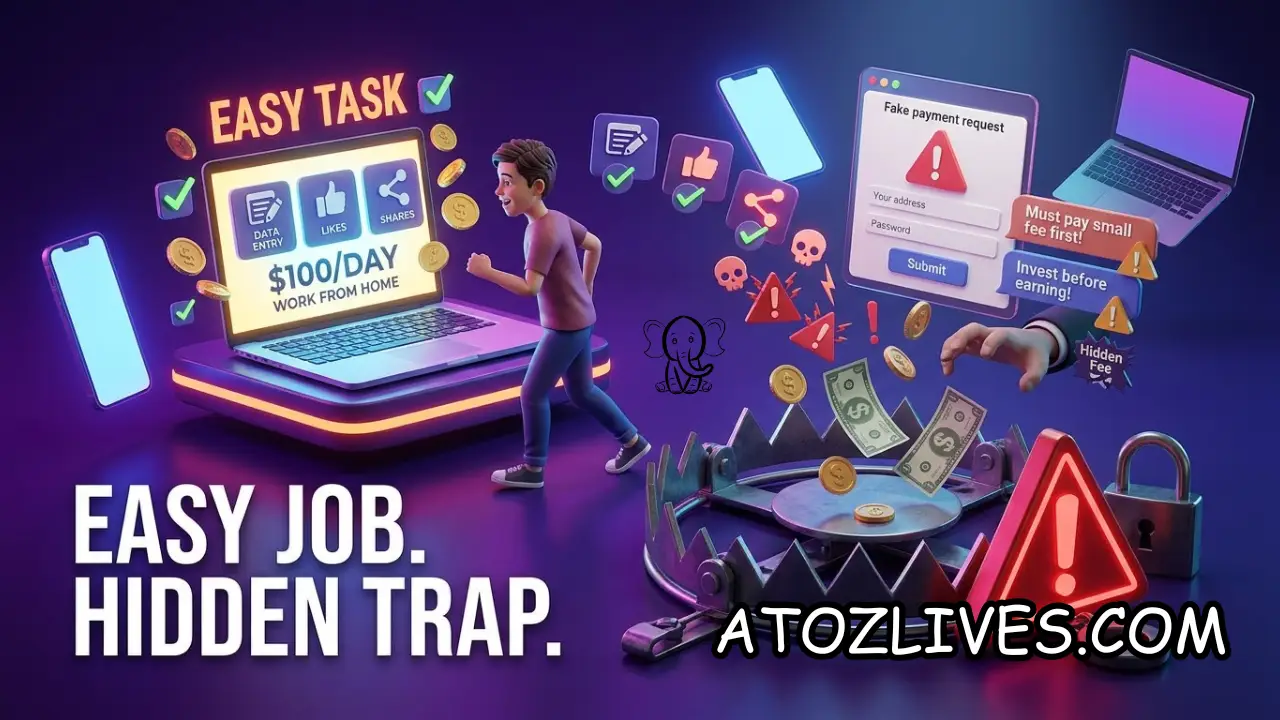
Task scams are fake online job opportunities designed to make people believe they can earn money by completing simple digital tasks.
The work may involve rating products, liking videos, reviewing images, “optimizing” apps, boosting products, or completing other repetitive activities. The offer often sounds easy because the scammer wants the job to feel accessible to almost anyone.
The Federal Trade Commission describes these schemes as “task scams” or “gamified job scams.” They commonly begin with an unexpected message through text, WhatsApp, Telegram, social media, or another online channel.
The person contacting you may claim that a company is hiring for flexible online work and that you can start earning quickly.
The scam becomes convincing because the supposed work platform may show a growing earnings balance. You might complete several tasks and see commissions added to your account.
The numbers can make the opportunity appear legitimate, even though the displayed earnings are completely controlled by the scammers.
In some cases, scammers may even send a small amount of real money at the beginning. The FTC says task scammers sometimes pay victims roughly $5 to $20 to gain their trust.
Once the victim believes the system is genuine, the scammer introduces a much larger financial demand.
That is what makes these scams different from an ordinary fake advertisement. The scammer is not simply asking for money immediately.
The victim is gradually moved from curiosity to participation, from participation to supposed earnings, and finally from supposed earnings to a demand for a personal deposit.
The central idea behind task scams is therefore simple: the job is only the bait.
The real objective is usually to convince you to send your own money or valuable personal information to the scammer.
Are You Ready To Get Paid To Review Apps On Your Phone Then Try It…
How a Fake Online Job Usually Turns Into a Money Trap
The process often starts with an unsolicited message. You may receive a text saying that a company is hiring remote workers, or someone may contact you through WhatsApp or Telegram with an opportunity to make money from home.
The job description is usually vague. Instead of explaining a normal role with specific responsibilities, the message may use phrases such as “product optimization,” “app boosting,” “online rating,” or “commission-based tasks.”
The FTC has repeatedly identified these types of descriptions as warning signs.
After you express interest, the scammer may send you to a website or app that looks professional. It may have a dashboard showing your account balance, task progress, commissions, rankings, or bonuses.
The appearance of the platform is designed to create confidence.
You may then be instructed to complete a few easy tasks. After each task, the dashboard displays additional earnings. At this point, the victim may think, “I am already making money, so this must be real.”
The next step is where the trap normally appears. The scammer says that you have reached a higher-level task, bonus package, premium order, or special commission opportunity.
To continue, you are told to deposit your own money.
Sometimes the scammer says the deposit is temporary and will be returned after completing the task. In other cases, they claim the payment is necessary to unlock your earnings.
The FTC warns that these supposed earnings are fake and that depositing real money does not unlock them.
The victim may continue depositing money because they can see a much larger balance on the screen.
The larger the fake balance becomes, the harder it can feel to walk away. This psychological pressure is an important part of how the scam works.
You can try it to save homes from the energy crisis and reduce electricity bills.
Why Scammers Use WhatsApp, Telegram, Text Messages, and Fake Recruiters
Unexpected communication is one of the biggest warning signs. Legitimate companies can recruit through many channels, but an unsolicited message promising easy money should immediately make you slow down and verify the opportunity independently.
The FTC’s recent 2026 warnings describe fake recruiters contacting people through text and offering supposed remote jobs.
In some cases, the recruiter may even use the name of a real company to appear credible.
A particularly important warning sign is when the recruiter wants you to respond with something simple such as “YES” or “INTERESTED.” The FTC says scammers may use this initial interaction to get you engaged before introducing the actual scam.
Social platforms also make impersonation easier. A scammer can use a company logo, professional-looking profile picture, copied job descriptions, and convincing graphics without actually being connected to the organization.
Fake recruiters may also create a sense of urgency. They might say that only a few positions remain or that you must complete registration immediately.
This pressure is intentional because people are more likely to skip verification when they fear losing an opportunity.
Another problem is that scammers can move conversations away from official company systems. Once communication happens entirely through a personal messaging account, it becomes harder for the victim to verify who is actually behind the offer.
The FTC advises people to verify job openings through contact information they independently know to be legitimate, rather than relying on contact details supplied by the supposed recruiter.
The safest approach is straightforward: if someone unexpectedly offers you an easy online job, do not treat the message as proof that a job exists.
Treat it as an unverified claim until you independently confirm the employer and position.
How to Start a Blog in 2025: A Step-by-Step Guide for Beginners
The Biggest Red Flags That Reveal Task Scams
The strongest warning sign is being asked to pay money to receive money. Legitimate employers do not require employees to deposit their own money to unlock wages or commissions.
The FTC repeatedly emphasizes that you should never pay to get paid or pay to get a job.
Another major warning sign is unusually high pay for extremely simple work. A message claiming you can make hundreds of dollars a day by clicking buttons, rating products, or completing a few minutes of online tasks deserves serious skepticism.
A legitimate job should have a recognizable economic explanation. Someone is paying you because you are providing a service, producing something valuable, solving a problem, supporting customers, or performing a defined business function.
A vague “commission” generated from clicking tasks is very different.
Unexpected job offers are another red flag. This is particularly true when you never applied for the position and the recruiter provides little information about why you were selected.
Pressure is also important. Legitimate employers generally give applicants time to understand an offer. A scammer may insist that you act immediately because urgency prevents careful research.
The FTC specifically recommends walking away from side-hustle offers that pressure you into quick decisions.
Requests for cryptocurrency should receive additional scrutiny. The FTC’s data on task scams found that cryptocurrency became a common payment method because transactions can be difficult to reverse.
Fake checks are another common job-scam technique. A supposed employer may send you a check and tell you to deposit it, keep part as your payment, and send the rest elsewhere.
The check can later turn out to be fraudulent, leaving you responsible for the money.
Finally, be careful with requests for sensitive information before you have verified the employer. Scammers may attempt to collect bank account information, Social Security numbers, driver’s license information, or other personal data.
Fake job scams can therefore create both financial and identity-theft risks.
You can use it to be healthy and fit forever.
Why Fake Earnings Screenshots and Small Payments Make Task Scams So Effective
One of the cleverest parts of a task scam is the fake earnings dashboard. The victim can see numbers increasing after completing tasks, which creates the impression that the work is producing real income.
The problem is that the balance is not necessarily connected to real money. The scammer controls the platform and can display almost any amount.
A balance of $200, $2,000, or $20,000 means nothing if the money cannot actually be withdrawn without sending additional funds.
The FTC explains that task scams deliberately create the illusion of earning money.
The supposed commissions displayed in the app are fake, even though the victim’s eventual deposit is real.
Small initial payments can make the deception even stronger. If someone receives $10 after completing a few tasks, they may conclude that the entire system is legitimate.
The payment is effectively an investment by the scammer in building trust.
The next time the platform asks for $100, $500, or $1,000, the victim may feel comfortable paying because they have already received something. This is where the scam can become expensive.
Group chats can make the situation even more convincing. The FTC has reported that scammers may place victims in group conversations where supposed experienced workers describe their success.
Those people may actually be part of the scam.
This is a form of social proof. When several people appear to be making money from the same opportunity, the victim may assume the opportunity has been independently validated.
The lesson is important: receiving a small payment does not prove that an online job is legitimate.
A real employer should not require you to deposit money to continue performing ordinary work.
If a platform says you have earned money but requires your own money before you can withdraw it, stop. Do not make another deposit simply because the displayed balance is getting larger.
Are You Excited To Read about AI Then Click Here…

How to Verify an Online Job Before You Give Money or Personal Information
The first step is to stop communicating with the recruiter long enough to research independently. Do not click links simply because the person sending them says they belong to a legitimate company.
Search for the company using information you find independently. The FTC recommends searching the company name together with words such as “scam,” “review,” or “complaint.”
This can reveal reports from other people who encountered the same operation.
Then visit the company’s official website yourself. Look for a careers section and search for the exact job title.
If the supposed position does not exist anywhere on the company’s legitimate website, that is a major warning sign.
Do not rely on a phone number or email address provided by the recruiter.
A scammer can easily provide a fake contact address that makes verification appear successful.
You should also examine the actual economics of the job. Ask what you will do, who the customer is, how you are paid, who pays you, and whether you must spend money to perform the work.
If the explanation becomes confusing whenever you ask basic questions, walk away.
The FTC recommends talking with someone you trust before accepting an unexpected side-hustle opportunity. Another person may notice problems that you overlooked because you are excited about earning extra income.
Never send cryptocurrency, gift cards, wire transfers, or money through a payment app because a supposed employer tells you it is required to unlock your salary.
These payment methods can make recovery difficult.
You should also be careful with equipment purchases. Some fake employers send a check or invoice and tell you to purchase equipment from a particular seller. The FTC warns that legitimate employers do not operate this way when hiring workers.
Verification should happen before payment, not afterward. Once money has been sent, recovering it can be significantly harder.
The basic test is simple: if the opportunity cannot survive independent verification, it should not receive your money or personal information.
You can use it for mental peace and balance.
What to Do If You Already Lost Money to a Task Scam
If you have already sent money to a task scam, stop communicating with the scammers. Do not send another payment because they promise that one final deposit will release your balance.
Scammers often create a second opportunity to steal money from people who have already been victimized. Someone may claim to be a recovery specialist who can retrieve your lost funds for an upfront fee.
Treat unexpected recovery offers with the same skepticism.
Contact the company or service you used to send the money as quickly as possible. Depending on how you paid, there may be steps you can take to report the transaction or request a reversal.
If cryptocurrency was involved, recovery can be particularly difficult.
The FTC’s data on task scams shows why scammers favor cryptocurrency for these schemes.
If you shared sensitive personal information, consider what accounts or services could be affected and take appropriate protective steps.
Change compromised passwords, enable multifactor authentication where available, and monitor financial accounts for suspicious activity.
You should also report the scam. In the United States, the FTC accepts reports through ReportFraud.ftc.gov.
Reporting does not guarantee that your money will be recovered, but reports help authorities identify patterns and investigate fraudulent operations.
If a scammer impersonated a specific company, contact that company independently through its official website and let its security or fraud team know. This can help the company warn other customers or applicants.
Do not feel embarrassed about being targeted. Task scams are designed to look legitimate and use psychological techniques that can affect careful people as well as inexperienced internet users.
The most useful lesson is to remember that legitimate work follows a simple direction of money: you provide valuable work, and the employer pays you.
When that relationship is reversed and you are asked to pay money to unlock your supposed earnings, you are no longer dealing with a normal job.
Want To Get Online Cash…
How to Find Legitimate Online Work Without Falling for Easy-Money Promises
Avoiding task scams does not mean giving up on online work. There are many legitimate ways to earn money remotely, but real opportunities usually require identifiable skills, time, experience, or useful services.
Freelancing is one example. A writer, designer, programmer, video editor, virtual assistant, translator, or consultant can provide a defined service and receive payment from a real customer.
Remote employment is another option.
A legitimate employer should be identifiable, the position should have clear responsibilities, and you should be able to verify the opening independently through the company’s legitimate channels.
Online businesses can also be legitimate, but they should have a clear business model. If you are selling a product, someone should actually be buying it. If you are providing a service, customers should be paying for that service.
And If you are using affiliate marketing, the income comes from qualifying purchases rather than deposits required to unlock fake commissions.
Do not judge an opportunity solely by how easy the first step appears. Legitimate online work can be simple, but it still has an economic reason for someone to pay you.
Be especially cautious of phrases such as “guaranteed income,” “no experience required,” “make hundreds daily,” “instant commissions,” and “deposit to unlock earnings.” The FTC identifies promises of big money for little effort and upfront payment demands as significant warning signs.
A good opportunity should become clearer when you ask questions. You should be able to understand what you are doing, who is paying you, what you will earn, what expenses exist, and how payments are made.
A bad opportunity often becomes more confusing. The explanation may move from one website to another, from a recruiter to a “manager,” or from ordinary tasks to increasingly large deposits.
The safest mindset is therefore not “How quickly can I make money?” but “How does this business actually generate money?” Once you understand where the money comes from, many fake opportunities become much easier to identify.
Task scams explained in simple terms: if an “easy online job” promises quick commissions and then asks you to deposit your own money to continue or withdraw earnings, treat it as a scam and walk away.
Are You Using Facebook, Twitter and YouTube (Get Paid To Use)
FAQs
1. What is a task scam?
A task scam is a fake online job that promises money for completing simple activities such as rating products, liking content, or performing “optimization” tasks. The scammer eventually asks the victim to deposit real money to continue or withdraw fake earnings.
2. How do task scams usually start?
They often begin with an unexpected text, WhatsApp message, Telegram message, social-media contact, or fake recruiter offering flexible online work.
3. Why do task scams show fake earnings?
The fake balance is designed to convince victims that they are earning real commissions. Seeing the number increase can make victims more willing to deposit their own money later.
4. Is it always a scam if an online job asks for money?
If an employer asks you to pay money to get a job or to receive your wages, that is a major scam warning sign. The FTC says legitimate employers do not require applicants to pay to get a job.
5. Why do scammers sometimes pay $5 or $20 first?
Small payments can build trust. The FTC says task scammers sometimes make small initial payments before asking victims to deposit larger amounts.
6. Can a legitimate employer contact me through WhatsApp or Telegram?
Communication through those platforms does not automatically prove fraud, but an unexpected job offer through messaging apps deserves careful verification. The FTC specifically warns about unexpected WhatsApp, Telegram, and text messages offering online work.
7. What does “pay to get paid” mean?
It means the supposed employer tells you that you must deposit money before receiving your salary or commissions. This is one of the clearest warning signs of a task scam.
8. What should I do if I deposited money into a task scam?
Stop sending money, contact the payment provider as soon as possible, secure any compromised accounts, monitor financial activity, and report the scam to the appropriate authorities. In the U.S., you can report it to the FTC at ReportFraud.ftc.gov.
9. Are cryptocurrency payments a warning sign in task scams?
Cryptocurrency is frequently used in task scams because payments can be difficult to reverse. The FTC has specifically documented substantial cryptocurrency losses connected with these scams.
10. How can I check whether an online job is legitimate?
Research the employer independently, verify the job on the company’s legitimate website, search the company name with “scam,” “review,” or “complaint,” avoid upfront payments, and discuss suspicious offers with someone you trust.
“Live Chat Jobs – You have to try this one”
Ready to Begin?
➜ Click Here to explore top-rated affiliate programs on ClickBank!
➜ Reach Our Free Offers: “Come Here To Earn Money By Your Mobile Easily in 2025.”
Want To Read More Then Click Here…
If You Are Interested In Health And Fitness Articles Then Click Here.
If You Are Interested In Indian Share Market Articles Then Click Here.
Thanks To Visit Our Website-We Will Wait For You Come Again Soon…