

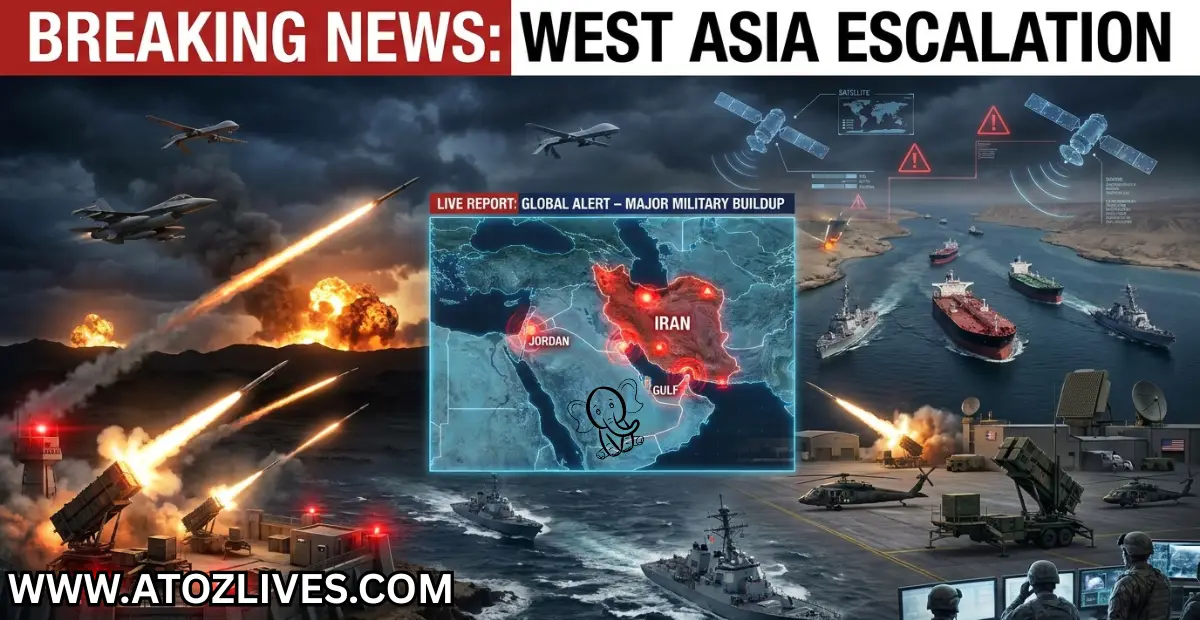
Tensions in West Asia escalated sharply on Wednesday after Iran launched missile and drone attacks against U.S. military installations in Jordan and several Gulf countries, following American strikes on Iranian targets near the strategic Strait of Hormuz.
The latest exchange marks one of the most serious confrontations between Washington and Tehran in recent months and has raised fears of a broader regional conflict.
According to reports, the United States carried out a series of military operations targeting Iranian radar systems, air-defense positions and other strategic facilities near the Strait of Hormuz.
The strikes were ordered after a U.S. Apache helicopter was reportedly brought down during heightened military activity in the region earlier this week.
American officials described the operation as a limited and defensive response rather than the start of a wider military campaign.
Iran responded within hours. The Islamic Revolutionary Guard Corps (IRGC) announced attacks on U.S.-linked military targets in Jordan and across the Gulf region.
Iranian media reported that long-range missiles and drones were used in the operation. Authorities in Jordan, Bahrain and Kuwait said most incoming threats were intercepted, and no major casualties were immediately reported.
The renewed hostilities have placed additional pressure on already fragile diplomatic efforts aimed at reducing tensions in the region.
President Donald Trump stated that the United States would respond firmly to any attacks on American personnel but also indicated that Washington remains open to a negotiated settlement if conditions allow.
Iranian officials, however, warned that further military action could trigger a stronger response from Tehran.
The conflict is also having economic consequences. Concerns over security in and around the Strait of Hormuz, one of the world’s most important energy shipping routes, pushed oil markets higher as traders assessed the risk of supply disruptions.
Analysts warned that continued military escalation could have significant effects on global energy prices and international trade.
As both sides exchange warnings and military activity continues, international observers are urging restraint. With diplomatic channels under strain and military forces on high alert, the situation remains highly volatile and could evolve rapidly in the coming days.