
AI freelancing in 2026 is moving away from the idea of simply selling AI-generated content.
Small businesses are increasingly interested in people who can use AI to solve practical problems, save time, improve marketing, organize information, and automate repetitive work.
That distinction matters. A business owner usually does not care whether a freelancer used an AI assistant, automation platform, spreadsheet, or another tool.
The owner cares about the result: better content, faster customer responses, cleaner research, more leads, or less repetitive work.
Current U.S. data supports this shift. The U.S. Census Bureau reported that business AI use remained around 17% to 20% during its December 2025–May 2026 measurement period.
While Goldman Sachs found that 93% of surveyed small businesses reported a positive business impact from AI, but only 14% said AI was fully integrated into their core operations.
That gap creates an opportunity for freelancers who can help businesses move from experimenting with AI to actually using it effectively.
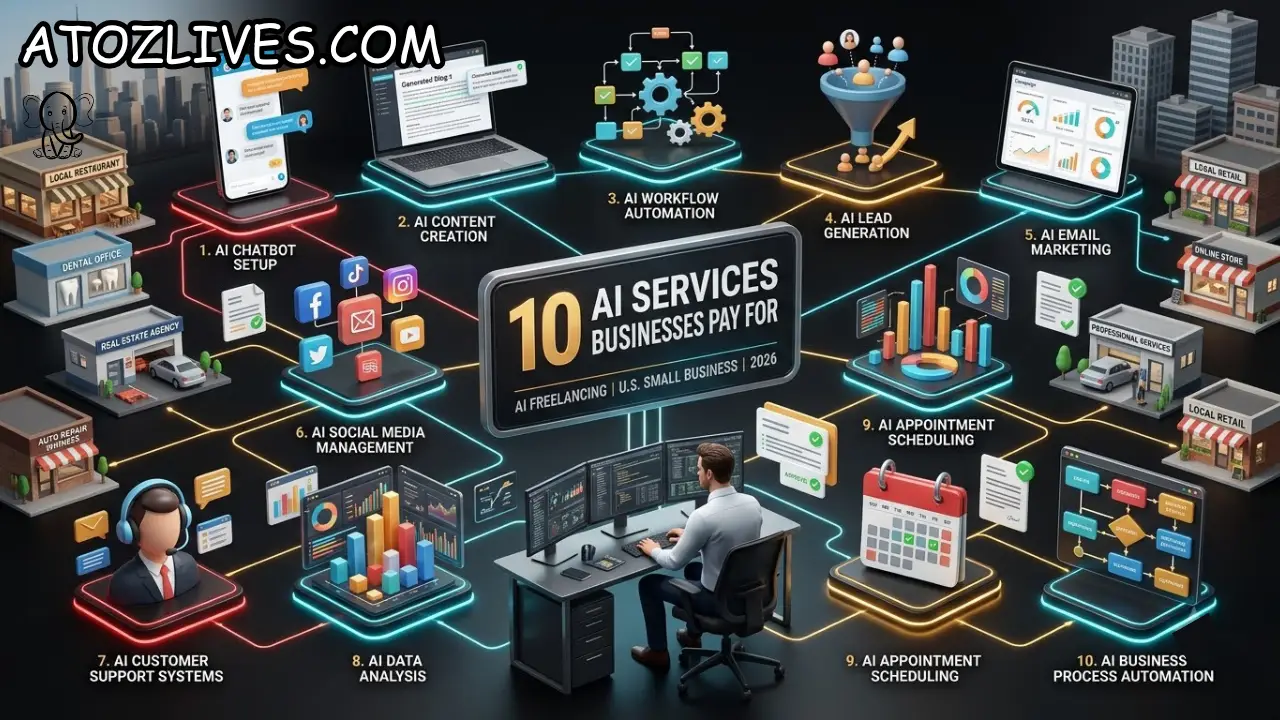
The following ten services are among the most practical areas to explore if you want to build an AI freelancing business without becoming a full-time software developer.
Are You Ready To Get Paid To Review Apps On Your Phone Then Try It…
1. AI Content Writing and Content Editing
Content remains one of the easiest areas for a freelancer to enter, but simply producing AI-written articles is becoming less valuable.
Businesses can already generate basic drafts themselves. What they need is someone who can turn rough AI output into accurate, useful, brand-appropriate content.
An AI content freelancer can help with blog posts, newsletters, website pages, product descriptions, email sequences, social media captions, FAQs, and other marketing materials.
AI can speed up research organization and first drafts, while the freelancer handles structure, fact checking, tone, editing, and final quality.
The most effective approach is to specialize. A freelancer could focus on content for local contractors, law firms, restaurants, real estate professionals, health and wellness businesses, SaaS companies, or professional services.
Specialization makes it easier to understand the customer’s audience and create content that feels less generic.
Businesses also need editing because AI-generated material can contain inaccurate claims, repetitive language, awkward phrasing, or information that does not match the company’s actual services.
A human editor can catch these problems before publication. That makes editing and quality control an important part of the service rather than an optional extra.
AI freelancing in 2026 therefore works best when the freelancer sells the outcome rather than the technology. “I use AI to write articles” is a weak offer.
“I create and edit four search-focused articles every month for local home-service companies” is a much clearer business service.
How to Start a Blog in 2025: A Step-by-Step Guide for Beginners
2. AI Social Media Content Management
Social media is another practical service because many small businesses know they need consistent content but do not have enough time to produce it.
AI can help a freelancer create content calendars, brainstorm topics, draft captions, adapt posts, and organize campaigns more efficiently.
A freelancer can create a monthly social media package for a business based on its products, customers, location, seasonal events, and marketing goals.
AI can generate starting ideas, but the freelancer should make the content specific to the actual business instead of publishing generic posts that could belong to any company.
Marketing is already one of the leading areas where small businesses are applying AI. A 2026 SBE Council survey identified marketing and content creation as a major small-business AI use case.
That gives freelancers an opportunity to combine marketing knowledge with AI-assisted production.
The service can also include content repurposing. A single customer testimonial, podcast episode, product demonstration, or long video can become several social posts, short-video concepts, email ideas, and website content.
The freelancer is essentially helping the business get more value from material it already has.
The strongest social media freelancers will not compete only on the number of posts they can produce. They will compete on relevance, consistency, audience understanding, and business results.
AI makes production faster, but strategy and judgment remain important.
Are You Excited To Read about AI Then Click Here…
3. AI Video and Short-Form Content Creation
Video has become an increasingly useful service for small businesses, especially businesses that need regular short-form content but cannot maintain an in-house production team.
A freelancer can help turn existing photos, product information, scripts, interviews, or long videos into short-form content.
AI can assist with scripting, captions, transcription, editing suggestions, scene planning, voiceover workflows, and content variations.
The freelancer can combine these capabilities with conventional editing tools to produce videos suitable for platforms such as YouTube Shorts, Instagram Reels, TikTok, or a company’s website.
This does not mean every business needs hundreds of AI-generated videos. In fact, producing large quantities of generic videos can hurt a brand.
A better service focuses on useful content that answers customer questions, demonstrates products, explains services, or communicates a business’s expertise.
Upwork’s 2026 marketplace data shows growing interest in AI-related roles, with AI video creator, AI video generation, and AI video ads among the rapidly growing AI-related searches on its marketplace.
That does not guarantee work for every freelancer, but it shows that clients are increasingly searching for specific AI-enabled creative capabilities.
A freelancer can make this service easier to sell by choosing a niche. For example, instead of offering “AI video services,” offer “12 short educational videos per month for real estate agents” or “product demonstration videos for e-commerce businesses.”
A clear deliverable makes the service easier for a business owner to understand and compare.
Want To Get Online Cash…
4. AI Research and Competitive Analysis
Research is another area where AI can dramatically reduce the time required to collect and organize information.
Small businesses often need competitor research, market summaries, customer-review analysis, product comparisons, industry monitoring, and basic business intelligence.
A freelancer can use AI to organize large amounts of information, identify recurring themes, summarize documents, and create an initial structure for a report.
The important human responsibility is checking the underlying information and separating reliable facts from assumptions or unsupported AI-generated claims.
Competitive analysis can be particularly useful for small businesses. A freelancer might compare competitors’ pricing, services, website messaging, customer reviews, content strategies, frequently mentioned customer complaints, and promotional offers.
The final report should focus on what the business can actually learn and use.
This service becomes more valuable when it produces a decision rather than a pile of information. A business owner does not necessarily need 50 pages of research.
They may need to know which competitors appear strongest, what customers complain about most often, where competitors have weak messaging, and what opportunities appear underserved.
Research also gives freelancers a path toward specialization. Someone who repeatedly researches restaurants, home-service companies, SaaS businesses, or e-commerce brands can develop a better understanding of the industry.
That knowledge can eventually become more valuable than the AI tools being used behind the scenes.
You can use it for mental peace and balance.
5. AI Email Marketing and Newsletter Services
Email remains useful for businesses because it provides a direct communication channel with existing customers and prospects.
Small companies may have valuable information to share but lack the time or expertise to turn it into regular newsletters and campaigns.
An AI-assisted email freelancer can help plan newsletters, organize topics, draft initial copy, create subject-line variations, segment content ideas, and repurpose existing business material.
Human editing remains important because email needs to sound like the actual company rather than a generic AI assistant.
A good service should focus on a business goal. That might be bringing previous customers back, promoting a seasonal service, introducing a product, educating subscribers, or nurturing potential customers who have already shown interest.
Freelancers can also build repeatable systems. For example, a local business might provide a monthly list of promotions, customer questions, recent projects, and announcements.
The freelancer turns that information into a polished newsletter while AI assists with organization and variations.
The opportunity is not simply “writing emails with AI.” The value comes from managing the complete process: gathering information, developing useful topics, creating drafts, editing them, checking links and details, and delivering a finished campaign that the business can actually use.
6. AI-Powered Customer Support Assistance
Customer service is another area where businesses are experimenting with AI, but that does not mean humans are disappearing from the process.
Many customers still want accurate answers and the ability to reach a person when a problem becomes complicated.
A freelancer can help a small business create customer-support knowledge bases, frequently asked questions, response templates, internal documentation, and AI-assisted workflows.
The goal is to make routine support faster while keeping humans involved when judgment or empathy is required.
For example, a business might repeatedly receive questions about shipping, appointments, cancellations, pricing, returns, opening hours, or basic product instructions.
A freelancer can organize those answers into a structured knowledge base and help the business use AI to locate or draft appropriate responses.
Accuracy is especially important here. An incorrect customer-service answer can cause refunds, complaints, lost customers, or reputational damage.
AI should therefore work from approved information rather than being allowed to invent policies or make promises.
The opportunity is supported by the growing adoption of AI in customer service. Talkdesk’s U.S. small-business research reported that 51% of small businesses surveyed had already integrated AI into customer service operations.
For freelancers, this means the opportunity is less about convincing businesses that AI exists and more about helping them implement it responsibly.
You can use it to be healthy and fit forever.
7. AI-Powered Lead Research and Sales Support
Lead research can be repetitive, making it a natural candidate for AI-assisted workflows. Businesses often need lists of potential customers, organized company information, contact research, competitor information, or personalized outreach ideas.
A freelancer can help identify prospects that fit a client’s criteria, organize available public business information, and prepare research notes for sales teams.
AI can assist with categorization, summarization, and personalization, while the freelancer checks the information before it reaches the client.
The important distinction is between useful research and mass spam. Businesses do not benefit from thousands of poorly targeted leads. A smaller list of relevant prospects with useful context can be much more valuable.
For example, a freelancer working with a commercial cleaning company could identify local businesses that match its target market, organize information about their locations and business type, and prepare concise research notes.
The sales team can then decide which prospects deserve outreach.
Privacy and compliance should also be considered. Freelancers should use legitimate sources, avoid collecting unnecessary sensitive information, and understand the applicable rules governing marketing communications and personal data.
The goal is to improve sales research, not create a database of questionable information.
8. AI Workflow Automation for Small Businesses
AI automation may offer some of the highest-value opportunities because businesses can pay for improvements that save employees time.
The service does not necessarily require traditional programming. Many modern platforms provide visual automation tools, integrations, forms, databases, and AI features.
A freelancer might automate tasks such as organizing incoming inquiries, summarizing customer messages, preparing reports, moving information between business applications, generating routine documents, or creating follow-up reminders.
The exact workflow depends on the business.
The first step should always be understanding the existing process. A freelancer should ask what employees currently do, how often they repeat it, where information gets lost, and which steps create delays.
Only then should AI or automation be introduced.
This approach is becoming more important because many businesses have experimented with AI without fully integrating it into their operations.
Goldman Sachs reported in March 2026 that only 14% of surveyed small businesses had fully integrated AI into their core operations despite 93% reporting positive business impact.
That gap represents a potential service opportunity for people who can turn isolated AI tools into practical workflows.
The best automation freelancers should also know when not to automate. Sensitive financial decisions, complex customer disputes, important legal matters, and other high-risk processes may require human review.
Good automation reduces unnecessary work while keeping appropriate controls in place.
You can try it to save homes from the energy crisis and reduce electricity bills.
9. AI Presentation, Document, and Business Material Design
Small businesses regularly need presentations, proposals, training documents, sales materials, internal guides, reports, and other business documents.
Creating these materials can take significant time, particularly for owners who are not comfortable with design or writing.
AI can help organize information, generate draft structures, summarize source material, and suggest presentation flows. A freelancer can then turn that material into a professional final document with consistent formatting and clear messaging.
This service is especially useful when the customer already has information but does not know how to present it. A business might have a collection of notes, statistics, product information, customer testimonials, and photographs.
The freelancer’s job is to turn those raw materials into something a customer, employee, or business partner can understand quickly.
Accuracy and brand consistency matter. A presentation containing incorrect numbers or invented claims can create serious problems.
Freelancers should therefore use the client’s original information as the foundation and verify important details before delivery.
This is also a good entry point for people who are already comfortable with presentation software, spreadsheets, graphic design, or business writing.
AI can increase production speed without requiring the freelancer to completely change their existing skill set.
10. AI Consulting and Implementation Support
The final service is broader and potentially more valuable, but it should not be the first offer for someone who has no practical AI experience.
AI consulting works when a freelancer understands business processes well enough to identify where AI can genuinely help.
A small business owner may know that AI is important but have no idea which tasks should be automated, which tools are appropriate, or how employees should use them.
A freelancer can review the company’s workflow, identify suitable use cases, recommend practical tools, and help implement a limited number of improvements.
The key is to avoid selling vague “AI transformation.” Small businesses generally benefit more from solving one concrete problem.
For example, improving lead follow-up, organizing customer inquiries, creating a content workflow, or reducing repetitive reporting can be easier to measure than promising to “transform the business with AI.”
Current research shows why implementation support can matter. JPMorganChase’s 2026 analysis specifically measures businesses paying for AI-related services, including marketing automation and generative AI, providing evidence of actual purchasing rather than simply stated interest.
AI consulting should also include training and documentation. If a freelancer installs a workflow that nobody understands, the client may become dependent on that freelancer or stop using the system altogether.
A better service leaves the customer with clear instructions, appropriate safeguards, and an understanding of what the system can and cannot do.
For a beginner, this can eventually become a progression: start with one AI-assisted service, learn how businesses use AI, understand recurring problems, build simple workflows, and then move toward implementation support.
That is a more credible path than calling yourself an AI consultant without practical experience.
Are You Ready To Get Paid To Review Apps On Your Phone Then Try It…
Conclusion
AI freelancing in 2026 is becoming less about generating something with a chatbot and more about combining AI with a useful professional service.
Small businesses have access to more AI tools than ever, but many still need help choosing, organizing, checking, and integrating those tools into everyday work.
That creates a practical opportunity for freelancers who can bridge the gap between technology and business needs.
The best starting point is not to offer ten services at once. Pick one area, such as content editing, social media management, research, video creation, or workflow automation.
Choose a specific customer group and build a simple offer around a problem that business owners already understand.
Most importantly, do not promise guaranteed income or unrealistic results. Build your reputation around accuracy, clear communication, reliable delivery, and measurable value.
AI can make a freelancer faster, but trust is still something a tool cannot provide by itself.
FAQs
1. What is AI freelancing in 2026?
AI freelancing means providing a paid service while using artificial intelligence to improve research, production, organization, analysis, or workflow efficiency. The freelancer remains responsible for the final result.
2. Can I start AI freelancing without coding skills?
Yes. Content editing, social media management, research, email marketing, video creation, document design, and several automation services can be started without traditional programming skills.
3. Which AI freelance service is easiest for beginners?
AI-assisted content editing and social media services are generally easier starting points because they can be built around skills many beginners already possess.
4. Which AI freelance service can have the highest value?
Automation and implementation can command higher-value projects because a successful workflow may save a business significant time. However, these services require more knowledge and responsibility.
5. Do small U.S. businesses actually pay freelancers for AI services?
Yes, businesses are already paying for AI-related tools and services, while freelance marketplaces are reporting growing demand for specialized AI skills. The challenge is demonstrating a useful business outcome rather than simply offering access to an AI tool.
6. Should freelancers tell clients that they use AI?
Transparency is generally the safer approach, especially when a client has specific policies about AI-generated work. The exact disclosure should depend on the service, contract, and client’s expectations.
7. Can AI completely replace an AI freelancer?
For some basic tasks, businesses can increasingly do the work themselves. That is why freelancers should focus on specialization, quality control, strategy, customer understanding, and implementation rather than selling simple AI-generated output.
8. How can I get my first AI freelance client?
Choose one specific service and customer type, create two or three strong examples, and contact businesses that have a clear need. A specific offer is usually easier to understand than a general “AI services” pitch.
9. Do AI freelancers in the U.S. have to pay taxes?
Generally, yes. The IRS says gig income is taxable, and net self-employment earnings of $400 or more generally trigger a federal filing requirement, including income from side work.
10. What is the biggest mistake in AI freelancing?
The biggest mistake is focusing on the AI tool instead of the customer’s problem. Businesses pay for useful outcomes such as better content, saved time, improved organization, or more efficient workflows.
“Live Chat Jobs – You have to try this one”
Ready to Begin?
➜ Click Here to explore top-rated affiliate programs on ClickBank!
➜ Reach Our Free Offers: “Come Here To Earn Money By Your Mobile Easily in 2025.”
Want To Read More Then Click Here…
If You Are Interested In Health And Fitness Articles Then Click Here.
If You Are Interested In Indian Share Market Articles Then Click Here.
Thanks To Visit Our Website-We Will Wait For You Come Again Soon…