
Starting an online business in 2026 does not necessarily require a large investment, an office, employees, or a complicated business plan.
For many people, a laptop, internet connection, a useful skill, and a focused offer can be enough to get started.
The real challenge is not finding an idea; it is choosing an idea that can generate revenue without requiring significant upfront capital.
A one-person online business can be especially attractive because you can control your schedule, keep operating costs low, and improve the business gradually.
Instead of spending thousands of dollars before getting your first customer, you can test an idea with a small budget and invest more only after you see evidence of demand.
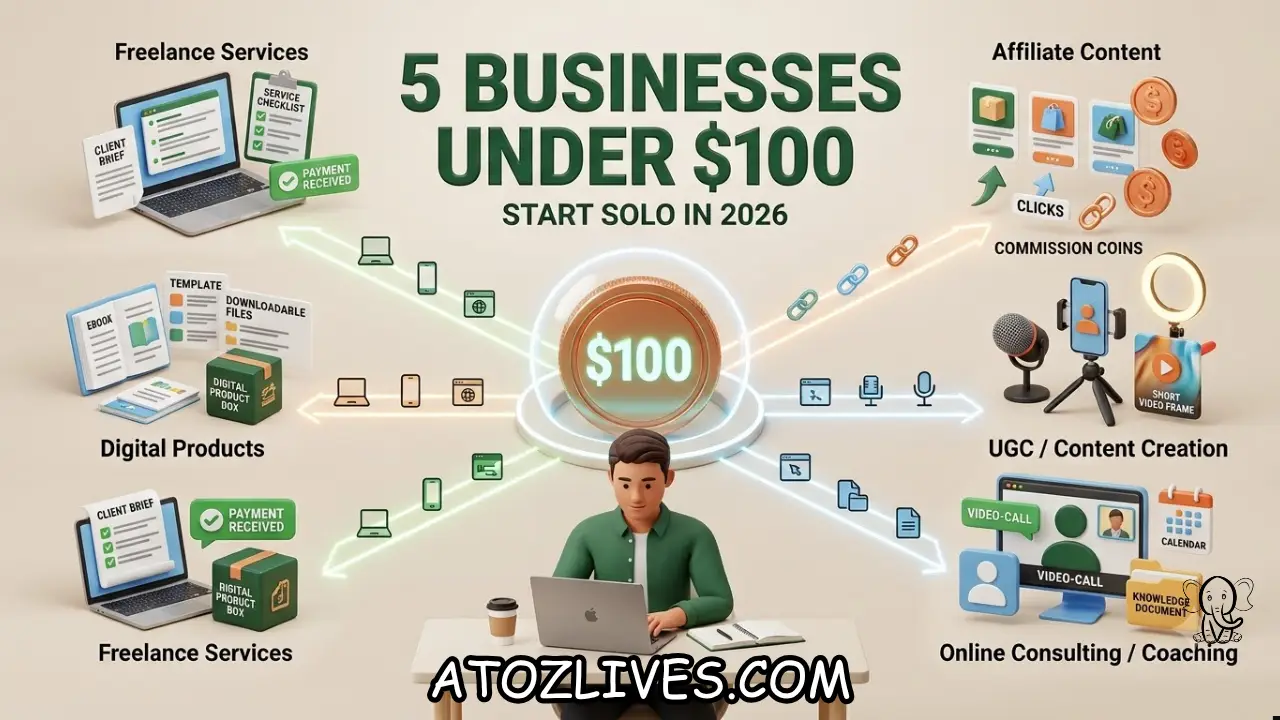
The best low-cost businesses usually fall into three categories: selling a service, selling a digital product, or building an audience that can eventually be monetized.
Freelancing, digital products, newsletters, content services, and specialized online consulting are examples of models that can be operated by one person.
The important point is that “under $100” does not mean “guaranteed money.” Your investment may be small, but your time, learning, marketing, customer service, and consistency still matter.
The U.S. Small Business Administration recommends understanding startup expenses, market research, customer segments, revenue streams, and cost structure before launching.
If you want to start a business without taking on significant financial risk, these five one-person online businesses are worth considering in 2026.
Each can be started lean, tested quickly, and expanded when customers begin paying.
Are You Ready To Get Paid To Review Apps On Your Phone Then Try It…
1. Freelance Writing, Editing, or AI-Assisted Content Services
Freelancing remains one of the simplest ways to start a one-person online business because you can sell a skill instead of buying inventory.
If you can write blog posts, edit articles, create product descriptions, write email copy, manage social media content, or improve AI-generated drafts, you can potentially turn that skill into a service business.
You do not need to build a large website before looking for customers. A simple portfolio containing three to five strong examples can be enough to demonstrate what you can do.
You can create sample articles, social media posts, product descriptions, or email campaigns specifically for your portfolio even if you have not yet worked with a paying client.
AI can also reduce the amount of time required for repetitive work, but the valuable part of the service should still come from your judgment.
Businesses do not simply need words generated by software. They need accurate information, appropriate tone, useful ideas, editing, fact-checking, original positioning, and content that makes sense for their audience.
Recent discussions around AI-powered work similarly emphasize using AI to improve productivity while maintaining human quality and judgment.
A basic starting budget could be less than $100 if you already own a computer and internet connection. You might spend money on a domain, a simple portfolio website, or one or two professional tools.
However, you can initially use free portfolio platforms and free communication tools and put most of your effort into finding potential customers.
The smartest approach is to specialize instead of advertising yourself as someone who “does everything.”
For example, you could offer blog writing for software companies, email writing for online stores, or short-form content for local businesses.
A narrow service makes it easier to explain your value and find people who actually need what you provide.
How to Start a Blog in 2025: A Step-by-Step Guide for Beginners
2. Digital Products Such as Templates, Guides, and Downloadable Resources
Selling digital products is another attractive one-person online business because there is no physical inventory to store or ship. You create the product once and can potentially sell the same file repeatedly.
Examples include spreadsheet templates, business checklists, resume templates, planners, social media calendars, presentation templates, educational resources, design assets, and practical guides.
The biggest mistake beginners make is creating a product first and looking for customers afterward. A better approach is to identify a specific problem that people repeatedly encounter.
If freelancers struggle to track invoices, create a simple invoice and income tracker. If job seekers struggle with applications, create a practical application organizer.
And If small businesses struggle with social media planning, create a content calendar designed for their industry.
Your initial costs can be extremely low. You can use free or inexpensive design and productivity software, create the product yourself, and sell it through a digital marketplace or your own website.
Some current low-cost business research also identifies digital products such as templates, planners, presets, ebooks, and prompt packs as particularly inexpensive models to test.
Pricing should reflect the usefulness of the product rather than simply how many pages it contains. A 10-page resource that solves an expensive business problem can be more valuable than a 100-page generic ebook.
Your sales page should clearly explain who the product is for, what problem it solves, what is included, and what the customer can realistically accomplish with it.
The major advantage of a digital product business is scalability, but sales are not automatic.
You still need traffic. Search engines, social media, YouTube, newsletters, communities, partnerships, and useful free content can all bring potential customers to your product.
Start with one excellent product rather than creating a large catalog nobody has requested.
Are You Excited To Read about AI Then Click Here…
3. A Niche Newsletter or Paid Information Business
A newsletter can be started with very little money, particularly if you focus on a specific topic rather than trying to compete with general media.
You could build a newsletter around personal finance education, technology updates, local business opportunities, career advice, software tutorials, industry news, productivity, or another subject where readers want useful information regularly.
The key is choosing a niche where you can consistently provide something valuable. “Technology news” is extremely broad. “Practical AI tools for small business owners” is more focused.
“Weekly software deals for freelancers” is even more specific. A narrow audience can be easier to understand, serve, and monetize than a massive general audience.
You can begin with a free newsletter platform and avoid spending your entire $100 budget immediately. The first objective should be proving that people actually want your information.
Create useful issues, promote them through relevant channels, and pay attention to which subjects attract subscriptions, replies, shares, and repeat readers.
Once an audience develops, several revenue options become possible. Depending on the niche and audience, a newsletter can potentially generate revenue through sponsorships, affiliate partnerships, paid subscriptions, digital products, consulting, or related services.
However, monetization usually becomes easier after you establish trust rather than immediately asking a tiny audience to buy something.
The newsletter model is particularly useful for someone who wants to build an asset rather than simply exchange hours for money.
Your archive can continue attracting readers through search and sharing, while your subscriber list gives you a direct relationship with your audience.
The downside is that audience-building can take time, so this model is better suited to people willing to publish consistently.
Want To Get Online Cash…
4. Social Media Content Services for Small Businesses
Many small businesses understand that they need an online presence but do not have the time to create consistent content.
This creates an opportunity for a solo operator to provide social media content services without becoming a full-service marketing agency.
You could create Instagram captions, Facebook posts, LinkedIn content, short video scripts, promotional graphics, content calendars, or simple monthly social media packages.
Instead of trying to serve every industry, choose one or two types of businesses such as restaurants, real estate professionals, fitness studios, dentists, home-service companies, or local retailers.
Your initial expenses can remain below $100 if you already have a computer and smartphone. Free design software, scheduling tools, cloud storage, and communication platforms can be enough to start.
Your first investment should primarily go toward making your work look professional rather than buying a long list of subscriptions.
The most effective offer is usually simple. Instead of telling a business owner that you provide “digital marketing solutions,” explain exactly what they receive.
For example, you could offer 12 social media posts, 12 captions, a monthly content calendar, and basic performance reporting. A clear package makes it easier for the customer to understand what they are buying.
You can also use AI to speed up brainstorming, first drafts, research organization, and repetitive tasks. However, the final content should be reviewed carefully.
Businesses need content that sounds appropriate for their brand and customers, not generic AI-generated posts that could belong to any company.
You can use it for mental peace and balance.
5. Online Tutoring, Coaching, or Specialized Consulting
If you already have a useful skill or area of expertise, teaching can become one of the most straightforward one-person online businesses.
You could tutor academic subjects, teach software, provide language practice, help beginners learn a professional skill, or offer specialized consulting based on your experience.
The advantage of this model is that you can start by selling your time before creating a complicated course. One-on-one sessions allow you to discover exactly what students or clients struggle with.
Those repeated questions can later become workshops, group classes, downloadable resources, or a full online course.
You do not need an expensive studio or complicated equipment. A computer, webcam, microphone, stable internet connection, and video-conferencing software can be enough.
If you already own the necessary equipment, your startup cost could be very small.
Your pricing should depend on the value and specialization of what you teach. General tutoring may have strong competition, while specialized knowledge can support higher prices when there is genuine demand.
Rather than competing only on being cheap, focus on a clearly defined outcome. For example, “helping beginners learn Excel for office work” is more specific than simply calling yourself an online teacher.
This model can also grow beyond one-to-one sessions. After you understand your students’ needs, you can create group sessions, workshops, downloadable study materials, recorded lessons, memberships, or consulting packages.
That creates the possibility of earning from multiple formats while still operating the business yourself.
How to Start a One-Person Online Business With Less Than $100
The first step is not spending money. It is choosing a problem and a customer. Write down three skills you already have and three groups of people who could benefit from those skills.
Look for the overlap. If you can write and understand local businesses, for example, you might offer social media content for local service companies.
Next, create one simple offer. Avoid building a complicated brand, buying expensive software, or creating dozens of services before you have customers.
Your first offer should solve one specific problem for one specific type of customer. This makes testing much faster.
Use your budget carefully. A possible $100 allocation could include a domain name, basic business software, a professional email address, and a small amount for testing promotion.
But you do not necessarily need to spend the entire amount. The SBA recommends identifying one-time and ongoing costs before launching so you understand how much capital your business actually requires.
Then start customer validation. Contact potential customers, publish useful content, offer a small initial service, or ask people about the problem you want to solve.
Your objective is to discover whether someone is willing to pay, not merely whether people say your idea sounds good.
Finally, keep your finances organized from day one. If you operate as a U.S. sole proprietor, business income and expenses generally need to be reported appropriately, and the IRS recommends keeping good records and separating business and personal expenses where practical.
You can use it to be healthy and fit forever.
Which One-Person Online Business Is Best for You in 2026?
The best one-person online business is not necessarily the one with the biggest theoretical earning potential. It is the one that matches your existing skills, available time, ability to reach customers, and willingness to continue learning.
If you need the fastest path toward your first potential customer, freelancing or social media services may be the most practical because you are directly selling a service. You do not have to wait for a large audience before making a sale.
If you prefer creating something once and selling it repeatedly, digital products may be a better fit.
Templates, guides, spreadsheets, educational resources, and other downloadable products can become scalable, although getting consistent traffic remains the major challenge.
If you enjoy writing, researching, and building an audience, a niche newsletter can become a long-term business asset.
It may take longer to monetize, but you can eventually combine subscriptions, sponsorships, affiliate income, products, and services.
If you have specialized knowledge, tutoring or consulting can be particularly attractive because you can start with one customer and learn directly from them.
Regardless of the model, the basic principle is the same: start small, validate demand, control expenses, and reinvest only when the business gives you a reason to do so.
You can try it to save homes from the energy crisis and reduce electricity bills.
FAQs
1. Can I really start an online business with less than $100?
Yes. Several service-based and digital-product businesses can be tested with less than $100, particularly if you already have a computer and internet connection. Your biggest investment will usually be time rather than money.
2. What is the cheapest online business to start in 2026?
Freelancing is among the cheapest because you can sell an existing skill without buying inventory. Writing, editing, virtual assistance, tutoring, consulting, and social media services can potentially be started with very little additional equipment.
3. Can a digital product business be started with $100?
Yes. A simple template, guide, spreadsheet, checklist, or other downloadable resource can be created using inexpensive or free tools. The bigger challenge is finding an audience and proving that customers actually want the product.
4. How quickly can I make money from an online business?
There is no guaranteed timeline. Service businesses can potentially generate a first sale faster because you can directly approach potential customers. Audience-based businesses usually take longer because you first need to build trust and reach.
5. Do I need an LLC to start an online business in the United States?
Not necessarily. Business structure requirements depend on your circumstances and location. A sole proprietorship is one common structure, but state and local requirements can vary.
The IRS notes that sole proprietors generally report business income and expenses through Schedule C.
6. Should I spend the entire $100 when starting?
No. Spending the full budget is not the goal. Keep costs as low as possible until you have evidence that people want your offer. Reinvest when a particular expense can reasonably improve your ability to deliver or acquire customers.
7. Can AI help me run a one-person business?
Yes. AI can help with brainstorming, research organization, drafting, content repurposing, customer-support workflows, and other repetitive tasks. However, human review remains important for accuracy, originality, tone, and business judgment.
8. Which online business is easiest for beginners?
A service business is often easier to understand because you exchange a clearly defined service for payment. Freelancing, tutoring, content creation, and social media management are practical starting points if you already have a useful skill.
9. Do I need a website before getting my first customer?
No. A website can help establish credibility, but it is not always necessary at the beginning. A strong portfolio, professional profile, clear offer, and direct communication can be enough to test demand before investing in a full website.
10. What should I do before launching my online business?
Define your target customer, identify a specific problem, create one clear offer, estimate your startup expenses, research competitors, and test whether potential customers are willing to pay.
The SBA specifically recommends market research, competitive analysis, business planning, and startup-cost calculations before launching.
“Live Chat Jobs – You have to try this one”
Ready to Begin?
➜ Click Here to explore top-rated affiliate programs on ClickBank!
➜ Reach Our Free Offers: “Come Here To Earn Money By Your Mobile Easily in 2025.”
Want To Read More Then Click Here…
If You Are Interested In Health And Fitness Articles Then Click Here.
If You Are Interested In Indian Share Market Articles Then Click Here.
Thanks To Visit Our Website-We Will Wait For You Come Again Soon…