

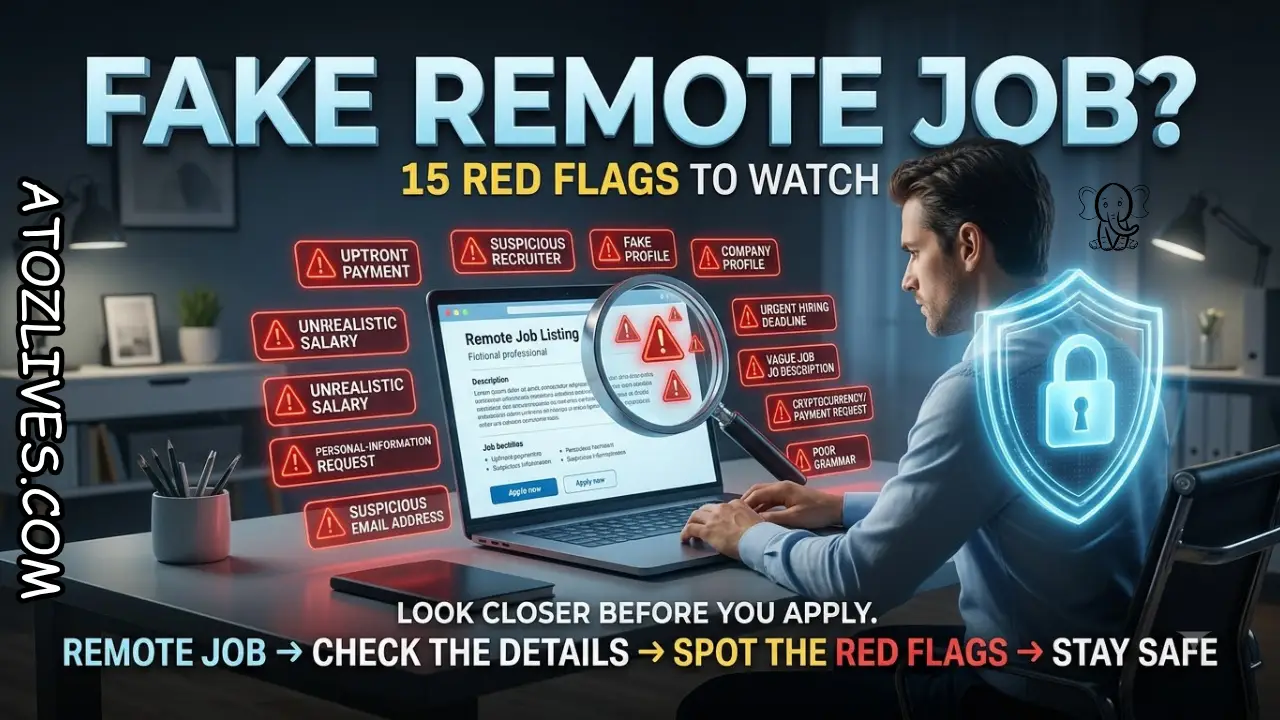
Remote jobs remain highly attractive in 2026. The ability to work from home, avoid commuting, and apply for positions across the country has changed how millions of Americans approach employment. Unfortunately, scammers have noticed the same trend. Fake remote jobs now appear on job boards, social media, messaging apps, email, and even platforms that people normally associate with legitimate employment.
The problem is that modern job scams can look surprisingly professional. A fake recruiter may use the name and logo of a real company, create a convincing job description, conduct a video interview, and send an official-looking offer letter. The Federal Trade Commission has warned that scammers impersonate well-known companies and use legitimate employment platforms to target job seekers.
In 2026, scammers are also using text messages and other unsolicited communications to offer fake remote positions. The FTC recently warned about fake recruiters who claim to represent legitimate companies and offer work-from-home jobs without providing meaningful details about the actual position.
That means job seekers cannot rely on appearance alone. A polished website, professional email signature, LinkedIn profile, or formal offer letter does not automatically prove that a job is real.
The good news is that most fake remote jobs leave clues. If you know what to look for, you can often identify a suspicious opportunity before sending money, personal information, or sensitive documents. These 15 red flags are among the most important warning signs Americans should know in 2026.
Are You Ready To Get Paid To Review Apps On Your Phone Then Try It…
A Recruiter Contacts You Unexpectedly With an Amazing Remote Job
One of the first warning signs is an unsolicited message offering you a remote position that seems almost too good to be true. You may receive a text, email, WhatsApp message, or social media direct message saying that a recruiter found your profile and believes you are perfect for a job.
The message may promise flexible hours, excellent pay, immediate hiring, and no previous experience. Sometimes the supposed recruiter gives very few details about the actual responsibilities. Instead, the conversation focuses on compensation and how quickly you can start.
This tactic has become especially relevant in 2026. The FTC has warned about fake recruiters contacting people by text and offering supposed work-from-home positions. Some messages mention jobs such as online assessor or simply describe the role as a “remote position” without providing meaningful information about the work.
An unexpected recruiter message is not automatically proof of fraud. Legitimate companies do recruit through direct outreach. The problem is when the recruiter cannot be independently verified and immediately pushes you toward a hiring process without giving you enough information to investigate the employer.
Before responding further, find the company’s official website yourself. Do not rely on a link provided by the recruiter. Search for the company, locate its official careers page, and determine whether the position actually exists.
The Salary Is Extremely High for Very Little Work
Another major warning sign is a promise of unusually high income for simple work. Scammers frequently use money as the primary attraction because people searching for remote employment may be especially interested in flexible positions with strong compensation.
A fake listing might claim that you can earn several hundred dollars every day by completing basic online tasks for a few hours. It may describe the job as data entry, product optimization, online reviewing, virtual assistance, or another simple role.
The FBI has specifically warned about work-from-home scams involving simple tasks such as rating restaurants or “optimizing” services. In some cases, victims are shown fake earnings inside a platform and then told to deposit cryptocurrency to unlock additional work or withdraw their supposed earnings.
A high salary by itself does not prove a job is fake. Some specialized remote positions genuinely pay well. The issue is whether the compensation makes sense for the responsibilities, experience requirements, employer, and industry.
Compare the position with legitimate listings for similar jobs. If an unknown company is offering dramatically higher compensation for easier work than established employers, slow down and investigate before accepting anything.
How to Start a Blog in 2025: A Step-by-Step Guide for Beginners
The Company Wants You to Pay Money Before You Start
This is one of the clearest red flags. A legitimate employer pays you for your work. You should be extremely suspicious if a supposed employer tells you that you must pay money to receive the job.
The request could be described as a registration fee, training fee, certification fee, background-check fee, equipment deposit, software fee, or account activation charge. The terminology changes, but the underlying demand is the same: you must pay money before you can earn money.
The FTC states that honest employers will not ask you to pay to get a job. Job seekers should never pay money simply because someone promises employment.
This also applies to supposed government positions. Information about federal jobs is publicly available, and the FTC warns consumers not to pay fees to obtain government or postal employment.
If a recruiter says the payment is refundable after your first paycheck, do not assume that makes it legitimate. A scammer can create convincing explanations for almost any upfront payment. Stop communicating and independently verify the company before providing money.
You Receive a Check and Are Told to Send Money Back
Fake-check employment scams are particularly dangerous because the check can initially appear to work. A supposed employer may send you a check for equipment, office supplies, training, or another business expense.
The scammer then tells you to deposit the check and send part of the money to a vendor, equipment supplier, another employee, or the recruiter. You may be instructed to use Zelle, PayPal, wire transfer, cryptocurrency, gift cards, or another payment method.
The problem is that the original check can later be determined to be fraudulent. The bank may initially make funds available, but that does not mean the check is legitimate. When the bank reverses the deposit, you can become responsible for the money you already sent.
The FTC specifically warns that honest employers do not send checks and then instruct new employees to send part of the money back. It has documented fake-check scams involving supposed remote employees and home-office equipment.
Never treat a deposited check as proof that a job is legitimate. If an employer sends you money and asks you to forward some of it elsewhere, stop the process and independently verify the offer.
Are You Excited To Read about AI Then Click Here…
The Recruiter Wants Your Social Security Number or Bank Details Too Early
Legitimate employers may eventually need information for payroll, tax forms, benefits, or background checks. The problem is providing highly sensitive information before you have verified who you are dealing with.
Scammers can use employment applications as a way to collect Social Security numbers, driver’s license information, bank details, addresses, and other information that may be useful for identity theft.
The FTC has documented fake recruiters who create convincing interviews and onboarding portals specifically to collect Social Security numbers and bank account information.
A request for personal information should therefore be considered in context. Ask yourself whether you have verified the employer, confirmed that the job exists, completed a legitimate hiring process, and established that the person requesting the information actually works for the company.
Never assume that a professional-looking online form is safe simply because it contains a company logo. Scammers can create convincing websites and forms.
The Job Description Is Vague About What You Will Actually Do
A legitimate employer should be able to explain the position. The job description should identify responsibilities, qualifications, expected working arrangements, and enough information for you to understand what you are applying for.
Fake listings often use vague language. They may promise that you will “assist clients,” “optimize products,” “process online orders,” or “complete simple tasks” without clearly explaining the company’s business model.
Some scams deliberately keep the job description vague because the scammer’s real objective is not employment. It may be to obtain money, personal information, cryptocurrency, or access to accounts.
The FBI has specifically identified fake work-from-home schemes involving simple “optimization” tasks and confusing compensation systems.
Before accepting a position, ask specific questions about the actual work. What department would you join? Who would supervise you? What software would you use? What customers or internal teams would you support? What would a typical workday involve?
If the recruiter repeatedly avoids answering basic questions about the job, treat that as a serious warning sign.
Want To Get Online Cash…
The Recruiter Uses a Personal Email Instead of a Company Domain
Email addresses can provide an important clue. If someone claims to represent a large company but contacts you from a generic Gmail, Outlook, or other personal email address, investigate carefully.
A personal email address does not automatically prove fraud. Small businesses sometimes use personal accounts, and legitimate recruiters can occasionally contact candidates through different systems. However, it becomes much more suspicious when the recruiter claims to work for a major corporation but cannot provide an independently verifiable corporate contact.
The FTC has specifically warned about fake recruiters using personal email addresses while impersonating legitimate companies.
Do not simply click the company’s name in an email signature. Search for the organization independently and find its official website. Then compare the recruiter’s information with the contact information published by the company.
Pay attention to small differences in domains too. Scammers can register domains that look almost identical to legitimate corporate domains. A single extra word, character, or unusual domain extension can matter.
The Interview Happens Only Through Text Messages
A text-based hiring process is not automatically fraudulent. Some legitimate employers use messaging for scheduling or initial communication. The concern is when the entire hiring process occurs through text, Telegram, WhatsApp, Signal, or another messaging platform without a credible interview or independently verifiable recruiter.
Scammers like messaging platforms because conversations can happen quickly and anonymously. They can send scripted questions, fake offer letters, payment instructions, and links without establishing a genuine employment relationship.
A legitimate employer should generally be able to explain the position, identify the hiring team, and provide a verifiable way to confirm the opportunity. The exact interview format can vary, but the overall hiring process should make sense.
Be particularly cautious if you are “hired” after answering a handful of generic questions and are immediately sent payroll forms or equipment instructions.
The FBI also advises people to be cautious about unsolicited job offers and not to click links, download files, or open attachments from suspicious messages.
Are You Using Facebook, Twitter and YouTube (Get Paid To Use)
The Company Website Looks Real but Cannot Be Independently Verified
A professional-looking website is not proof that an employer is legitimate. Scammers can build websites that contain company descriptions, employee photos, testimonials, job listings, and contact pages.
Instead of asking whether the website looks professional, ask whether the company can be independently verified. Search for its business presence, established contact information, legitimate employees, news coverage, professional records, and other credible references.
The FTC recommends searching for the company name together with words such as “scam,” “review,” or “complaint.” It also recommends independently checking job openings through the company’s official website.
Be especially careful when the job link is different from the company’s actual website. A fake careers portal can be designed to collect your information while looking almost identical to a real employer’s site.
Do not let a polished website pressure you into making a fast decision. Professional design is easy to imitate. Independent verification is much harder to fake.
You Are Pressured to Make a Decision Immediately
Urgency is another common scam tactic. The recruiter may tell you that only a few positions remain, that you must accept the offer within an hour, or that you will lose the opportunity if you do not provide information immediately.
Real employers can have deadlines, but pressure should not prevent you from verifying an employment opportunity. You should be able to research the company and ask reasonable questions before accepting a job.
Scammers benefit from urgency because careful research takes time. If you stop and verify the company, you may discover that the recruiter is not actually connected to the organization.
Never let fear of missing a job override basic safety. A legitimate employer should understand that candidates need to review an offer and employment terms.
If someone becomes aggressive or repeatedly discourages you from checking the opportunity, consider that a major warning sign.
You can use it for mental peace and balance.
The Job Requires Cryptocurrency Payments or “Unlock Fees”
Cryptocurrency has become a particularly important warning sign in fake remote employment schemes. The FBI has warned about scammers who create fake work platforms showing supposed earnings and then require victims to make cryptocurrency payments to unlock tasks or withdraw money.
The scam may initially appear harmless. You might complete simple tasks and see a growing balance on a website or app. The displayed amount can create the impression that you are already earning money.
Eventually, the platform tells you that you need to deposit money before completing a higher-paying task or withdrawing your earnings. The supposed balance is not necessarily real.
This is fundamentally different from a legitimate employer paying you. You should never have to purchase cryptocurrency to unlock your paycheck.
If an alleged employer tells you that you must deposit money to access work or earnings, stop immediately.
The Recruiter Asks You to Reship Packages From Your Home
Reshipping scams are another type of fake remote job that can look like legitimate employment. You may be hired as a quality-control worker, personal assistant, package inspector, or logistics employee.
The supposed employer sends packages to your home and instructs you to inspect, repackage, and forward them elsewhere. The FTC warns that these jobs can involve merchandise purchased with stolen payment information.
You may be promised a salary after completing a certain number of shipments. Unfortunately, the paycheck may never arrive, and the company can disappear after receiving the packages.
Receiving and forwarding merchandise for an unknown employer can also create serious legal and financial complications. You do not necessarily know where the products came from or why they are being shipped.
If a remote job primarily involves receiving packages at your home and forwarding them to addresses provided by strangers, walk away.
You can use it to be healthy and fit forever.
The Recruiter Claims to Represent a Famous Company
Scammers know that recognizable company names create trust. The FTC has warned about criminals impersonating well-known companies on LinkedIn and other job platforms.
They may copy company logos, use real employee names, reproduce legitimate job descriptions, and create fake interview documents. Some even create onboarding portals that appear official.
The safest response is to separate the company from the recruiter. Ask whether the job itself exists on the employer’s official careers page. Then independently contact the company through information found on its legitimate website.
Do not use the phone number or email address provided exclusively by the recruiter to verify the recruiter.
Remember that scammers do not need to invent an entire company. They can simply impersonate a real one.

The Job Requires You to Buy Gift Cards or Use Unusual Payment Methods
Requests for gift cards are an especially strong warning sign. A supposed employer may tell you to purchase gift cards for equipment, software, employee rewards, or another business purpose and then send them the codes.
Legitimate employers do not normally require employees to purchase gift cards as part of the hiring process. Once the codes are sent, the money can be extremely difficult to recover.
The FTC warns that scammers may insist on payment through gift cards, cryptocurrency, payment apps, or wire services because these methods can be difficult to reverse.
The same principle applies when a recruiter insists that you use a particular payment service to receive or send money.
If employment suddenly turns into a payment transaction, stop and investigate. A job should not require you to transfer money to your supposed employer.
You can try it to save homes from the energy crisis and reduce electricity bills.
How to Verify a Remote Job Before Giving Personal Information
The safest approach is to verify the opportunity independently before providing sensitive information. Start by finding the company’s official website yourself rather than clicking the recruiter’s links.
Search the company name along with terms such as “scam,” “complaint,” and “review.” The FTC recommends this as a basic research step, while also noting that the absence of complaints does not guarantee that an employer is legitimate.
Check whether the exact position appears on the company’s official careers page. If it does not, contact the company through a phone number or email address published independently on its website and ask whether the position and recruiter are genuine.
Do not send Social Security numbers, bank information, driver’s license details, passwords, or other sensitive information simply because someone says it is required for onboarding.
Finally, discuss suspicious offers with someone you trust. The FTC specifically recommends talking to someone before accepting questionable job opportunities because another person may notice warning signs you missed.
If you believe you encountered a job scam, you can report it to the FTC at ReportFraud.ftc.gov. If you encounter an online employment scam involving cryptocurrency or other internet crime, the FBI’s Internet Crime Complaint Center also provides a reporting channel.
FAQs
1. How can I tell if a remote job is fake?
Look for requests for upfront payments, unusually high pay for simple work, fake-check instructions, cryptocurrency deposits, vague job descriptions, unsolicited recruiter messages, and requests for sensitive information before the employer is verified.
2. Do legitimate remote jobs ask for money upfront?
Generally, no. The FTC states that honest employers do not ask applicants to pay to obtain a job. Requests for training fees, equipment deposits, registration fees, or similar payments should be treated as major warning signs.
3. Can scammers use LinkedIn and Indeed to post fake jobs?
Yes. The FTC has warned that scammers impersonate legitimate employers and use legitimate job platforms to contact applicants. Finding a job on a recognizable platform does not automatically prove that the employer or listing is genuine.
4. Is a remote job offering $50 an hour automatically a scam?
No. High-paying remote jobs exist. The warning sign is an unusually high salary combined with little experience, minimal work, vague responsibilities, or pressure to provide money or personal information.
5. Should I deposit a check from a remote employer?
Do not deposit an unexpected check and then send money elsewhere based on instructions from a supposed employer. The FTC specifically warns about fake-check employment scams.
6. Can a fake recruiter use a real company’s name?
Yes. Scammers frequently impersonate real companies and recruiters. Verify the job through the company’s independently located official website rather than trusting information supplied by the recruiter.
7. Are work-from-home data-entry jobs always scams?
No. Legitimate data-entry positions exist. However, data-entry scams are common, so verify the employer, job description, compensation, recruiter, and hiring process before providing information.
8. Is cryptocurrency a red flag in a remote job?
If an alleged employer requires you to send cryptocurrency to unlock work, increase earnings, or withdraw your supposed salary, treat it as a major scam warning. The FBI has specifically warned about this type of work-from-home scheme.
9. What should I do if I already sent money to a fake employer?
Contact the company or payment service you used immediately and ask whether the transaction can be reversed. Also report the scam to the FTC. Depending on the circumstances, additional reporting to the FBI’s IC3 or other authorities may be appropriate.
10. What is the safest way to find legitimate remote jobs?
Start with reputable job sources, but independently verify every employer. For federal positions, use USAJobs.gov, which the FTC identifies as the official federal government employment site. Never pay someone to obtain a government job.
“Live Chat Jobs – You have to try this one”
Ready to Begin?
➜ Click Here to explore top-rated affiliate programs on ClickBank!
➜ Reach Our Free Offers: “Come Here To Earn Money By Your Mobile Easily in 2025.”
Want To Read More Then Click Here…
If You Are Interested In Health And Fitness Articles Then Click Here.
If You Are Interested In Indian Share Market Articles Then Click Here.
Thanks To Visit Our Website-We Will Wait For You Come Again Soon…