
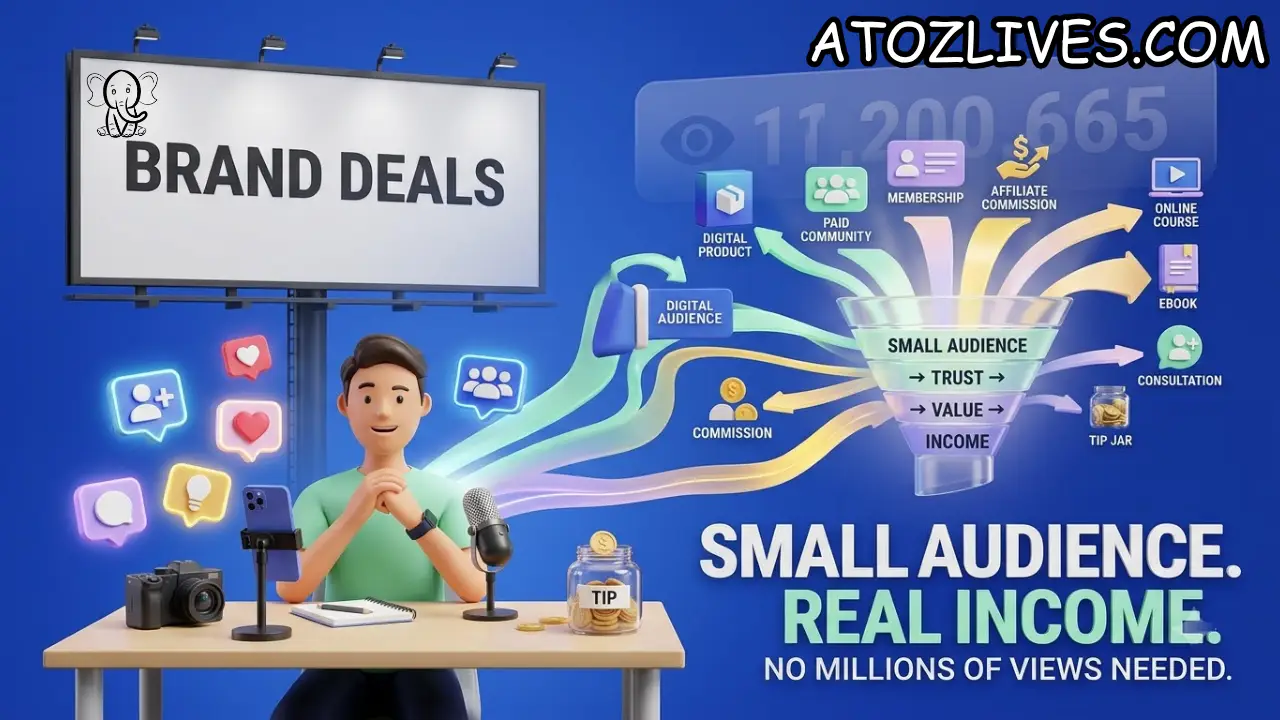
You do not need a million followers, millions of video views, or a long list of brand sponsors to make money as a creator. In 2026, small creators have more ways to turn a focused audience into income than simply waiting for companies to offer sponsorships.
The biggest misconception about creator income is that audience size automatically determines earnings. In reality, the quality of an audience and its relationship with a creator can matter just as much. A creator with 2,000 people who genuinely trust their recommendations may have more monetization opportunities than someone with 100,000 followers who rarely pays attention to their content.
A small creator can earn through affiliate marketing, digital products, memberships, paid communities, services, subscriptions, tips, and platform monetization. Some of these methods require relatively little audience size because they depend more on what the audience wants than on the total number of followers.
YouTube is a good example. Eligible creators can access certain fan-funding and Shopping features through the expanded YouTube Partner Program at the 500-subscriber level, provided they also meet the applicable upload and watch-hour or Shorts-view requirements. Full ad-revenue eligibility has a higher threshold.
That changes the strategy for beginners. Instead of asking, “How do I get millions of views?” a better question is, “What problem can I solve for the people already watching me?” A small but relevant audience can be valuable when the creator offers something genuinely useful.
Are You Ready To Get Paid To Review Apps On Your Phone Then Try It…
Affiliate Marketing Can Turn a Small Audience Into Real Revenue
Affiliate marketing is one of the most accessible monetization methods for small creators because you do not need to create or manufacture the product yourself. You recommend a product or service through a tracked link, and you may receive a commission when someone makes a qualifying purchase.
The key is relevance. A creator with a small audience should not randomly promote products simply because an affiliate program offers a commission. The recommendation needs to fit the content and solve a problem that the audience already has.
For example, a creator who teaches beginner photography could recommend camera accessories, editing software, lighting equipment, memory cards, or online courses. A creator who makes home-office videos could recommend webcams, microphones, desks, productivity software, and other tools.
A small audience can therefore become commercially useful when the audience has strong buying intent. Ten thousand random viewers may be less valuable than 1,000 people actively searching for a solution to a specific problem.
Creators also need to be transparent about affiliate relationships. The FTC says influencers should clearly disclose material connections with brands, including financial relationships. For affiliate links, the FTC recommends clear and conspicuous disclosure close to the recommendation or link.
This is important because trust is one of the strongest assets a small creator has. If viewers believe every recommendation is simply an attempt to make a commission, the relationship can weaken. Honest recommendations, including explaining when a product is not suitable, can make affiliate content much more credible.
Digital Products Let Small Creators Sell Knowledge Instead of Chasing Views
Digital products can be particularly attractive for creators with specialized knowledge. Instead of depending entirely on advertising or sponsorships, you can package something useful and sell it directly to your audience.
The product does not have to be a huge online course. A beginner creator could sell a checklist, template, spreadsheet, ebook, guide, planner, prompt collection, resource library, design template, meal planner, study material, business document, or specialized tutorial.
The advantage is that the product can be designed around a very specific problem. A creator teaching personal budgeting, for example, could sell a simple budget spreadsheet rather than attempting to create a massive financial education course.
This approach works particularly well for small creators because the audience does not need to be enormous. If 1,000 people follow a creator because they have a specific problem and even a small percentage become customers, the creator may generate meaningful revenue without needing viral reach.
The challenge is creating something people actually want. A common mistake is building a product based entirely on what the creator thinks is interesting. A better approach is to examine comments, questions, emails, community discussions, and repeated audience problems.
A small creator can also use free content to demonstrate expertise and make the paid product a natural next step. The free content answers part of the problem, while the paid product saves the customer time or provides a more complete solution.
How to Start a Blog in 2025: A Step-by-Step Guide for Beginners
Services Can Be More Profitable Than Waiting for Sponsorships
Creators often overlook services because they are focused on becoming influencers. But a small creator can turn the same skill used to produce content into a service business.
A creator who makes short-form videos could offer video editing. Someone who creates attractive social posts could offer social media design. A creator who writes educational content could provide writing or content strategy services.
This model does not require a huge audience. In fact, the content itself can act as a portfolio. Potential customers can see what you can do before contacting you.
Services can also produce revenue with relatively few customers. A creator charging $300 for a specialized service would need only a few clients to generate meaningful monthly income. The exact price depends on the skill, market, experience, scope, and value delivered.
The disadvantage is scalability. Unlike a digital product, a service usually requires your time for every customer. If demand grows significantly, you may eventually need to raise prices, standardize the service, create packages, outsource work, or build a team.
For a beginner, however, that limitation can actually be useful. Services provide direct conversations with customers. Those conversations can reveal problems that later become digital products, courses, templates, or other scalable offers.
Memberships and Fan Support Reward Audience Loyalty Instead of Audience Size
A small but loyal audience can also support a creator through memberships and fan-funding features. The concept is simple: people who value your content can pay regularly or make voluntary payments to support your work.
YouTube currently provides several fan-funding options to eligible creators, including channel memberships, Super Chat, Super Stickers, and Super Thanks. Its expanded Partner Program allows eligible creators to access certain monetization features at lower thresholds than full advertising revenue.
Memberships are particularly interesting because they are based on recurring payments rather than individual purchases. A creator might offer members exclusive videos, private discussions, early access, downloadable resources, behind-the-scenes material, or other meaningful perks.
The important word is “meaningful.” A creator should not launch a membership simply because the platform provides the button. People need a reason to pay every month. The benefit needs to be clear enough that members feel they are receiving something worth the recurring cost.
Small creators can also create direct communities outside major platforms, depending on their audience and business model. A paid newsletter, private community, educational group, or specialized resource library can create another relationship between the creator and audience.
This model works best when the creator has developed trust. Someone may ignore a generic creator with 100,000 followers but happily pay a small monthly amount to a creator whose content consistently helps them solve a problem.
Are You Excited To Read about AI Then Click Here…
Small Creators Can Build Multiple Income Streams Without Going Viral
The strongest creator businesses often do not depend on one source of income. A small creator can combine several modest revenue streams rather than waiting for one huge opportunity.
For example, a technology creator could earn affiliate commissions from recommended software, sell a troubleshooting guide, offer one-on-one consultations, and earn YouTube revenue when eligible. None of these channels individually needs to produce enormous amounts of money for the combined business to become meaningful.
Another creator might focus on fitness education and combine a paid digital guide, affiliate products, a membership community, and personalized services. Again, the audience does not need to be enormous if the audience is highly relevant.
This approach also reduces risk. Platform algorithms can change, advertising rates can fluctuate, affiliate programs can change their terms, and sponsorship opportunities can disappear. Owning several monetization channels gives the creator more control.
However, diversification does not mean launching everything immediately. Trying to build a membership, course, newsletter, affiliate website, merchandise store, and consulting business at the same time can overwhelm a beginner.
A better strategy is to start with one monetization method that naturally matches your existing content. Once it works, add another method that serves the same audience. This creates a connected business instead of a collection of unrelated money-making experiments.
The goal is not to make every follower buy something. The goal is to create several legitimate ways for the people who genuinely value your work to support it.
The Real Advantage Small Creators Have Is Trust, Not Reach
Small creators sometimes believe they are disadvantaged because they cannot compete with major influencers. But being small can provide an important advantage: closer relationships with the audience.
When an audience is relatively small, creators can often respond to comments, answer questions, notice recurring problems, and understand what their viewers actually need. That information can become the foundation for monetization.
A creator should therefore treat comments and direct feedback as business research. If viewers repeatedly ask for a particular template, tutorial, consultation, product recommendation, or resource, there may be a real opportunity.
Trust also means refusing to recommend something simply because it pays well. A creator who promotes unsuitable products may generate a few short-term commissions but damage the relationship that makes future income possible.
The FTC’s guidance emphasizes that endorsements should reflect honest experiences and opinions and that creators should not make unsupported claims about products. This is particularly important for small creators because credibility is often their biggest competitive advantage.
Creators should also avoid measuring success exclusively through follower count. Better metrics can include returning viewers, email subscribers, affiliate clicks, product sales, membership retention, inquiries, customer satisfaction, and revenue per engaged audience member.
Ultimately, small creators can make money without brand deals or millions of views because monetization is not only about reach. It is about relevance, trust, useful offers, and the ability to solve a problem for a specific group of people.
A creator with 1,000 highly engaged followers can build a real business if those followers have a reason to listen, trust the creator’s recommendations, and purchase something genuinely useful. The process may be slower than a viral success story, but it is often much more realistic and sustainable.
Want To Get Online Cash…
FAQs
1. Can small creators really make money without brand deals?
Yes. Small creators can use affiliate marketing, digital products, services, memberships, subscriptions, fan support, and platform monetization. Brand sponsorships are only one possible income source.
2. How many followers do I need to start making money?
There is no universal follower requirement. Some monetization methods depend more on customer intent and trust than audience size. You can potentially earn your first dollar from a very small audience if you offer something relevant.
3. Can I make money from YouTube without millions of views?
Yes. Eligible YouTube creators can earn through several features besides advertising, including memberships, Super Thanks, Super Chat, Super Stickers, and Shopping. Eligibility requirements vary by feature.
4. What is the easiest way for a small creator to make money?
There is no universally easiest method. Affiliate marketing can be simple to start, services can produce direct revenue, and digital products can be scalable. The best option usually matches your skills and audience.
5. Are affiliate links worth using with a small audience?
They can be, especially when the audience has strong interest in the products you recommend. A small, targeted audience can generate more useful affiliate activity than a large but unrelated audience.
6. Can I sell a digital product with only 1,000 followers?
Yes. Follower count does not guarantee sales, but 1,000 relevant followers can provide a useful starting audience. A specific product solving a specific problem is generally easier to explain and sell than a generic product.
7. Do small creators have to disclose affiliate relationships?
Creators should clearly disclose material connections with brands. The FTC specifically recommends clear and conspicuous disclosure for affiliate relationships and other financial connections.
8. Is YouTube advertising the best way for small creators to make money?
Not necessarily. Advertising can be one income stream, but smaller creators may also benefit from products, services, affiliate commissions, memberships, fan funding, and Shopping features depending on eligibility.
9. What should a small creator sell first?
Start with something closely connected to what your audience already asks you about. This could be a service, template, guide, resource, consultation, or relevant affiliate recommendation.
10. Should I wait until I have thousands of followers before monetizing?
No. Waiting for a large audience can delay learning what your audience actually values. You can begin testing appropriate monetization methods early, provided the offer genuinely helps your audience and you remain transparent about commercial relationships.
“Live Chat Jobs – You have to try this one”
Ready to Begin?
➜ Click Here to explore top-rated affiliate programs on ClickBank!
➜ Reach Our Free Offers: “Come Here To Earn Money By Your Mobile Easily in 2025.”
Want To Read More Then Click Here…
If You Are Interested In Health And Fitness Articles Then Click Here.
If You Are Interested In Indian Share Market Articles Then Click Here.
Thanks To Visit Our Website-We Will Wait For You Come Again Soon…